
Online HIPAA certification for couriers is the documented completion of an accredited training course covering the HIPAA Privacy Rule, Security Rule, and Breach Notification Rule, delivered through an internet-accessible platform that allows individual couriers and courier company workforces to complete instruction on any device without classroom scheduling, and that produces a verifiable certificate usable for pre-employment screening, client credentialing, and employer onboarding documentation. The online delivery format is not simply a convenience for courier workers. It reflects the operational reality of courier work, where staff are distributed across routes, dispatch locations, client facilities, and variable shift patterns that make fixed-location training impractical for most organizations and individuals in the sector. The HIPAA Journal offers an individual certification course for medical couriers and a separate workforce training course for medical courier companies, each addressing the same federal regulatory framework but structured for different enrollment and recordkeeping contexts.
Why HIPAA Training Is a Legal Obligation for Medical Couriers
Medical couriers qualify as HIPAA Business Associates when they transport Protected Health Information on behalf of a Covered Entity. That classification is not contingent on whether the courier reads or processes patient information. Regulators treat medical couriers as having operational access to PHI as an inherent feature of their service, which means the Business Associate designation applies to specimen transport, medical record delivery, prescription logistics, and any other courier function where PHI is handled on behalf of a hospital, laboratory, physician practice, or other HIPAA Covered Entity.
HIPAA Business Associate Status of Medical Couriers
HIPAA Business Associate status creates a direct obligation under the HIPAA Security Rule at 45 CFR 164.308(a)(5) to implement a security awareness and training program for all workforce members. For medical courier companies, that obligation applies to drivers, dispatch staff, supervisors, and office personnel whose roles involve any contact with PHI or PHI-related documentation. For independent couriers operating as contractors, the obligation applies personally. An independent courier cannot rely on a client healthcare organization’s internal training program to satisfy their own Business Associate training requirement. They must obtain training independently, and an online certification course is the practical mechanism for doing so before a contract assignment begins.
Why Online Delivery Fits the Courier Workforce
The courier workforce does not congregate at a single facility on a predictable schedule. Drivers complete routes across multiple pickup and delivery locations each day. Schedules shift based on client volume, route changes, and assignment availability. New contractors may need to complete HIPAA training and produce a certificate before their first assignment, sometimes within days of being engaged. A classroom-based training model cannot accommodate those conditions at scale.
Online certification removes the scheduling constraint entirely. A courier can complete the training between shifts, during off-hours, or in the days before a new contract begins. The course is accessible on a mobile phone, which is the device most couriers carry throughout their workday. Pause-and-resume access means a session does not need to be completed in one sitting, which accommodates the interrupted schedules that characterize active delivery work. The certificate is issued immediately after the required modules and assessments are finished, which means a courier can produce proof of training the same day the course is completed rather than waiting for a mailed document or a scheduled certification date.
What the Individual Certification Course Covers
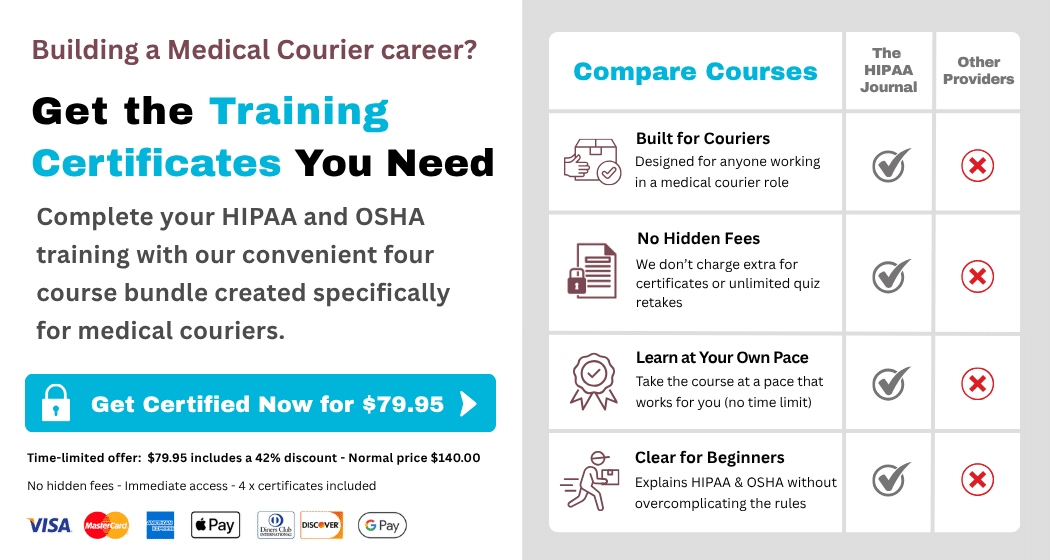
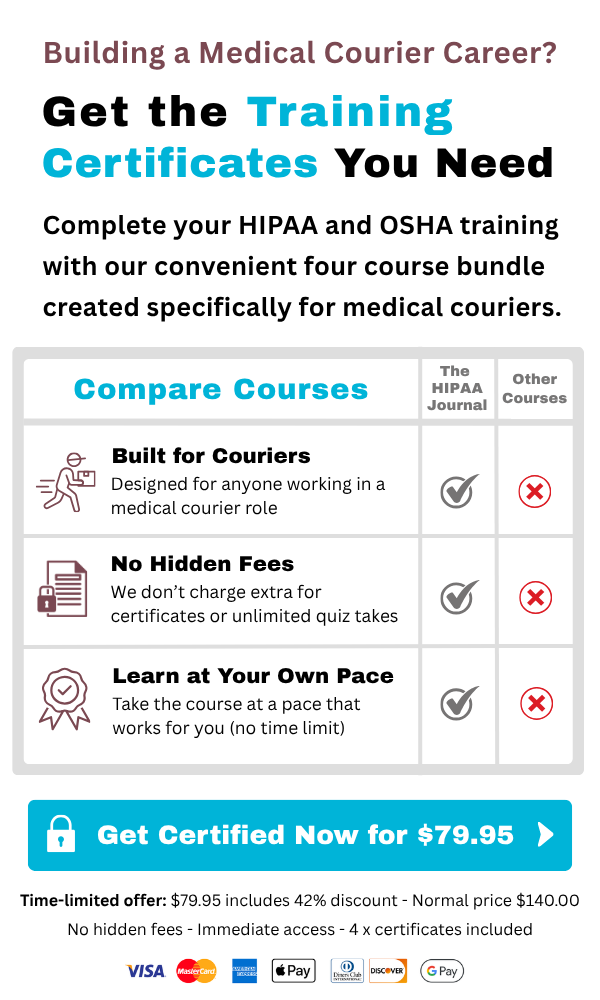
HIPAA Certification for Medical Couriers from The HIPAA Journal is an accredited online course that takes approximately 30 minutes to complete and is structured for individual couriers completing training for onboarding, pre-employment verification, or annual refresher requirements. The mandatory modules address the HIPAA Privacy Rule and how it governs the use and disclosure of PHI, the Security Rule and the safeguard obligations that apply to electronic PHI handled during courier operations, and the Breach Notification Rule and what couriers must do when a potential disclosure incident occurs. Each mandatory module ends with a short multiple-choice quiz. There is no limit on quiz retakes and no cumulative exam at the end of the course.
The curriculum addresses the compliance scenarios that arise specifically in courier work rather than presenting regulatory text without operational context. Couriers encounter PHI in manifests, chain-of-custody records, delivery documentation, specimen labels, and electronic tracking systems. The course connects the federal rules to the decisions couriers make when handling those materials, including how to respond to a lost or misdelivered package, how to apply the minimum necessary standard when accessing route documentation, and when and how to escalate a suspected PHI incident through the correct reporting channel.
Optional HIPAA Training Modules
Optional modules addressing Texas state medical privacy requirements under HB 300 and California medical privacy regulations are included at no additional cost for couriers who operate in those states. Both Texas and California impose obligations beyond the federal HIPAA framework, and couriers working in those jurisdictions face dual compliance exposure if their training addresses only the federal rules. After the mandatory modules and certificate are completed, more than ten supplementary reference and advanced modules remain available through the 12-month access period, covering topics including generative AI risks, social media conduct, HIPAA violation consequences, and emergency disclosure situations.
How the Certification Process Works
After purchase, course access is available immediately. The learner sets up an account using an email address and password and enters the course through the learning management system. The first step is to access the course on whichever device is available, including mobile phones, tablets, laptops, and desktop computers. The second step is to work through the lessons at an individual pace, using pause-and-resume controls to stop and return as needed without losing progress. The third step is to complete the short quiz at the end of each mandatory module, retaking as many times as needed until a passing score is achieved. The fourth step is to receive the accredited certificate, which is issued immediately after all required modules and quizzes are finished and is available for download as a PDF document.
How the Certificate Is Used in Practice
Healthcare clients request proof of HIPAA training from couriers before assigning contracts, granting facility access, or proceeding with a Business Associate Agreement. The certificate from a recognized and accredited provider satisfies that requirement in a format that can be attached to an email, included in a contract application, or provided during onboarding without requiring the client to contact the training provider. Clients and employers who want to verify the certificate’s authenticity can do so directly through The HIPAA Journal’s verification service, which confirms the certificate without requiring the courier to be present in the process.
For individual couriers, the HIPAA certificate serves as personal documentation of HIPAA training completion that accumulates across years of operation. A courier who holds a current certificate dated within the prior 12 months can demonstrate to any new client or employer that their training is current without delay. For courier companies managing multiple contractors, requiring a current individual certificate as a condition of engagement shifts the training documentation burden to the contractor level while still satisfying the organization’s obligation to work with trained individuals who handle PHI on its behalf.
Workforce HIPAA Training for Medical Courier Organizations
Medical courier companies that employ drivers, dispatchers, and support staff need a workforce training option rather than individual course purchases for each team member. HIPAA Training for Medical Courier Employees from The HIPAA Journal is structured for organizational deployment, allowing employers to assign the same baseline course to all workforce members, track completion across the team, and retain training records that satisfy the six-year documentation retention requirement under the Security Rule. That recordkeeping function is not available through individual certification purchases, which produce records for the learner rather than for the organization.
The employee training course addresses the same federal regulatory framework as the individual certification course but is built for bulk enrollment and employer-managed documentation rather than self-directed individual purchase. The workforce covered by the employer course extends beyond drivers to include dispatch personnel, supervisors, and administrative staff whose roles involve routing records, account documentation, or any other information that identifies or references a patient. The difference between the two courses is one of scale and administrative structure. The individual course serves a courier who needs certification for personal use. The employee course serves an organization that needs to build and document a compliant workforce training program across multiple staff members simultaneously.
 PJ Murray is the founder and publisher of The HIPAA Journal. He has more than 10 years of experience writing about HIPAA, healthcare compliance, patient privacy, and the protection of medical records. Through The HIPAA Journal, PJ helps healthcare organizations, business associates, and their employees better understand HIPAA regulations, reduce compliance risks, and strengthen the safeguards used to protect patient information.