
Texas does not issue a medical courier license, and what clients and courier services refer to as a “medical courier license” is certification in federal HIPAA rules, the state privacy law known as HB 300, and OSHA standards, which healthcare clients require before assigning work involving Protected Health Information or biological specimens. No state licensing board regulates medical courier work in Texas in the way that licensing applies to occupations such as nursing or commercial driving.
Medical Courier Certification, Not a License
The requirement healthcare clients impose on medical couriers in Texas is certification, obtained by completing training and passing assessments, rather than a license issued by a state agency. Medical practices, laboratories, and hospitals require this certification as a condition of the vendor relationship, since their own compliance obligations depend on working with couriers who can demonstrate documented training on Protected Health Information handling and applicable safety standards. Referring to this requirement as a license is inaccurate, but the practical effect is similar: a courier without the certification will generally not be assigned client work.
What the Medical Courier Certification Must Cover
HIPAA staff training is mandatory under 45 CFR § 164.530(b), which requires covered entities and Business Associates to train employees on policies and procedures relating to Protected Health Information, alongside the Security Rule’s separate training requirement at 45 CFR § 164.308(a)(5). HIPAA training and certification is therefore legally mandatory for medical couriers.
HB 300 training is mandatory under Texas Health and Safety Code § 181.101, which requires every covered entity, including medical courier companies, to provide employees with training on state and federal law concerning Protected Health Information, completed within 90 days of hire and repeated at least every two years. HB 300 training and certification is therefore legally mandatory for medical couriers in Texas.
OSHA Bloodborne Pathogens training is mandatory under 29 CFR § 1910.1030(g)(2), which requires employers, including medical courier companies, to provide training to employees with occupational exposure to blood or other potentially infectious materials at the time of initial assignment and at least annually thereafter. Bloodboarne Pathogens training and certification is therefore legally mandatory for medical couriers in Texas, which clients typically also requiring OSHA Hazard Communication certification and Personal Protective Equipement certification.
A medical courier in Texas holding only general HIPAA certification has not met the Texas-specific or OSHA components that medical courier clients typically expect.
Obtaining the Medical Courier Certification Clients Require
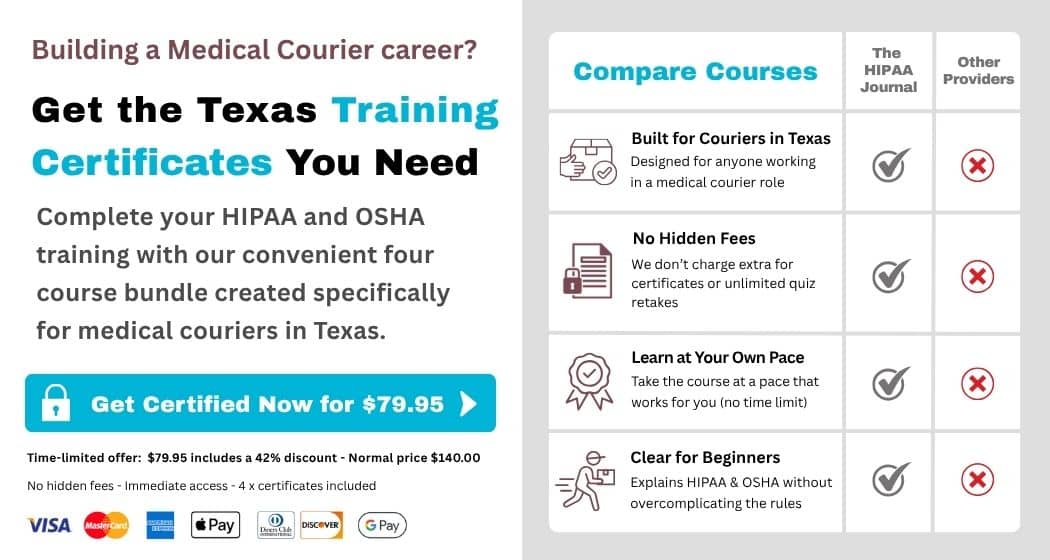
The HIPAA Journal’s Medical Courier Certification in Texas is a four-course online training bundle designed for medical couriers who transport Protected Health Information, specimens, and hazardous materials in Texas. The bundle combines HIPAA training covering the HIPAA rules andh a Texas State Medical Privacy and Security Regulations course addressing HB 300 and related Texas statutes, and three OSHA modules covering Bloodborne Pathogens, Hazard Communication, and Personal Protective Equipment. The course is completed online with pause-and-resume access on any device, includes a short quiz after each lesson with unlimited retakes, and issues a certificate for each course on completion that can be downloaded or printed and provided to clients or an employer as documented evidence of compliance. The bundle is priced at $79.95, discounted from a standard price of $140.00.
 PJ Murray is the founder and publisher of The HIPAA Journal. He has more than 10 years of experience writing about HIPAA, healthcare compliance, patient privacy, and the protection of medical records. Through The HIPAA Journal, PJ helps healthcare organizations, business associates, and their employees better understand HIPAA regulations, reduce compliance risks, and strengthen the safeguards used to protect patient information.