
HIPAA certification is obtained by completing an online HIPAA certification course covering the HIPAA Privacy Rule, HIPAA Security Rule, and HIPAA Breach Notification Rule, passing the assessments attached to each module, and receiving a certificate of completion upon meeting all course requirements. This certificate serves as documentation for job applications, onboarding files, and workforce training records. The steps involved are consistent across most accredited providers, though the depth of instruction and the credibility of the issuing organization vary considerably.
What a HIPAA Certification Confirms
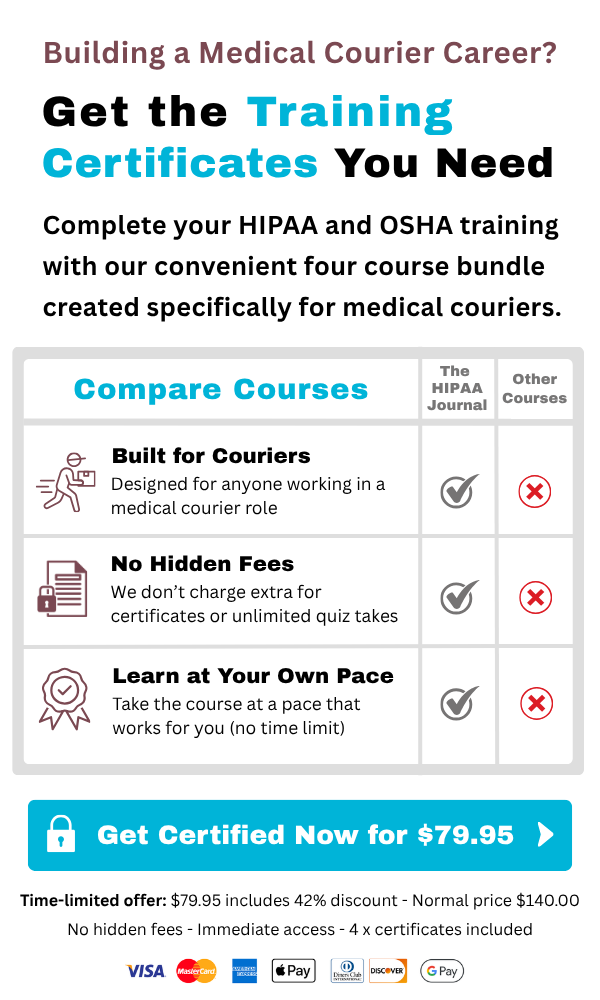
A HIPAA certification confirms that an individual has completed formal instruction on the three federal rules governing protected health information. It does not replace employer-specific policies and procedures, which differ by organization and are typically covered separately during onboarding. The HIPAA certification provides proof that staff have an understanding of HIPAA rules and regulations. Staff will also receive training on internal procedures build on top of HIPAA once a new hire joins a medical practice or organization. Couriers providing delivery services for medical providers also require HIPAA certification for medical couriers.
Step One: Registration and Account Access
Registration for the Accredited HIPAA Certification sets up a learner account and grants immediate access to the training platform. The course can be accessed from a mobile phone, tablet, laptop, or desktop device, which allows a learner to begin from whichever device fits their schedule at the time of registration.
Step Two: Completing the Training Modules
The course runs on a pause-and-resume format, allowing a learner to complete all lessons in a single sitting or spread across several sessions. Total completion time runs approximately 40 minutes. Mandatory modules cover the HIPAA Privacy Rule, HIPAA Security Rule, and HIPAA Breach Notification Rule, along with patient rights, disclosure guidelines, and threats to electronic protected health information. Optional state-specific modules address additional privacy requirements in Texas and California.
Step Three: Passing Module Assessments
Each module ends with a short quiz rather than a single comprehensive exam at the end of the course. A learner can retake any quiz as many times as needed to reach a passing score, with no cap on attempts. This structure ties assessment directly to the material just reviewed, rather than testing recall of the full course at once.
Step Four: Receiving the Certificate
The certificate is issued immediately once all required modules are complete and all assessments are passed. It can be downloaded right away for job applications, onboarding files, or workforce training documentation. The Accredited HIPAA Certification also includes free verification through The HIPAA Journal, allowing an employer or hiring organization to confirm the certificate’s authenticity directly.
The table below explains these steps.
| Step | Estimated Time | Learner Action |
|---|---|---|
| Registration and Account Access | Under 5 minutes | Create a learner account and select a device to begin training. |
| Completing the Training Modules | Approximately 40 minutes | Complete mandatory modules using pause-and-resume access. Note that medical courier certification for Texas is longer due to the additional training requirements to accommodate state laws |
| Passing Module Assessments | Approximately 5 minutes | Complete each module quiz, retaking as needed to pass. |
| Receiving the Certificate | Immediate | Download the certificate upon completion of all modules and quizzes. |
What Happens After Certification?
Completion of the mandatory Accredited HIPAA Certification modules unlocks a set of advanced reference modules at no additional cost, covering topics such as the role of a HIPAA Compliance Officer, preventing common violations, and compliance considerations for artificial intelligence tools and social media use. These modules are available for ongoing reference after the mandatory certification requirements are met, giving a learner a resource to return to as questions come up in day-to-day work.