
To work as a medical courier in Texas, you need to meet driving and vehicle qualifications and complete certification covering federal HIPAA rules, the state privacy law known as HB 300, and OSHA standards for bloodborne pathogens, hazardous chemicals, and personal protective equipment. This training is mandated by law rather than left to individual company discretion: HIPAA training is required under 45 CFR § 164.530(b) and 45 CFR § 164.308(a)(5), HB 300 training is required under Texas Health and Safety Code § 181.101, and OSHA Bloodborne Pathogens training is required under 29 CFR § 1910.1030(g)(2). Because these training requirements are set by law and mandatory, healthcare clients will insist on proof of this training before hiring medical couriers.
Driving Record, Vehicle, and Insurance Requirements
A prospective medical courier needs a valid Texas driver’s license and a clean driving record. Courier companies and clients typically look for no more than two moving violations within the past two to three years and no DUI convictions within the past five years. A reliable vehivle is needed to transport specimens, medical records, and other materials. The care and the driver must have auto liability insurance. Independent medical courier contractors are often required to have higher insurance coverage limits than a standard personal policy provides and may be required to have professional auto insurance.
Equipment For Handling Specimens and Hazardous Materials
A medical courier needs insulated cooler bags and ice packs for temperature-sensitive specimens, tamper-proof transport bags and biohazard spill kits for materials requiring secure handling, and personal protective equipment such as disposable gloves to reduce the risk of exposure during transport.
Certification in HIPAA and Texas Privacy Laws, including HB 300
A Texas medical courier needs certification showing an understanding of how federal HIPAA rules apply to Protected Health Information encountered during pickup, transport, and delivery, including permitted disclosures, safeguards, and breach reporting. Texas Health and Safety Code Chapter 181, amended by HB 300, applies on top of federal HIPAA and defines a covered entity broadly enough to include any individual or organization that assembles, collects, analyzes, uses, evaluates, stores, or transmits Protected Health Information in Texas, a definition that includes medical courier services. Certification should also address the other Texas statutes that apply alongside HB 300, including the Texas Identity Theft Enforcement and Protection Act, the Texas Data Privacy and Security Act, the Texas Responsible AI Governance Act, SB 1188, and the Texas Medical Practice Act. Certification limited to federal HIPAA content does not cover these mandatory Texas-specific obligations.
Certification in OSHA Safety Standards
Because courier work can involve blood, blood samples, and hazardous chemicals, a Texas medical courier also needs certification in OSHA safety requirements. This includes Bloodborne Pathogens certification covering Universal Precautions and exposure response, Hazard Communication certification covering chemical labeling and Safety Data Sheets, and Personal Protective Equipment certification covering the selection and proper use of protective gear. The BloodBorne Pathogens training in particular is mandatory under OSHA laws.
Registering as an Independent Contractor
A courier planning to operate independently, rather than as an employee of a courier company, also needs to register a business entity in Texas, such as an LLC, obtain an Employer Identification Number, and open a separate business bank account. This structure allows an independent courier in Texas to contract directly with healthcare clients as a 1099 contractor.
Certificates That Prove Regulatory Compliance for Clients
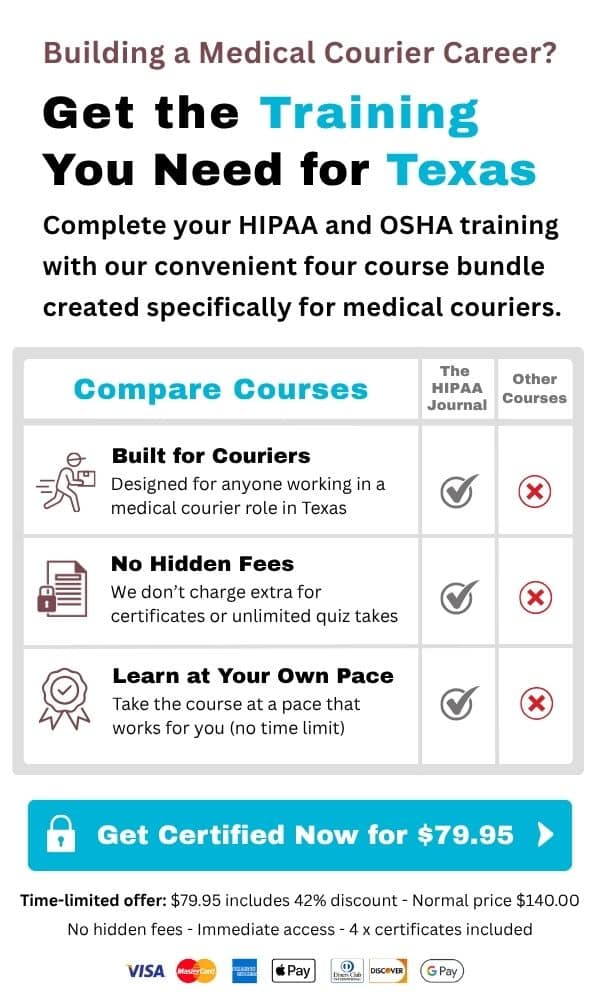
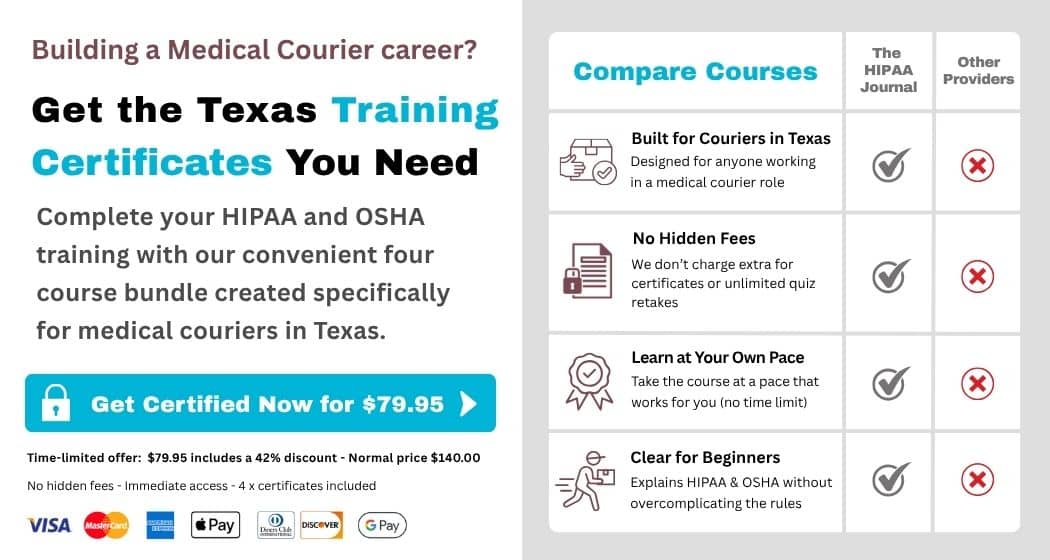
Beyond meeting the driving, vehicle, and certification requirements above, a Texas medical courier needs a certificate that documents completion of this training, since healthcare clients generally request proof before establishing a working relationship. The HIPAA Journal’s Medical Courier Certification in Texas provides this documentation through a single course bundle covering HIPAA, HB 300, and the three required OSHA modules. The course is completed online, includes a short quiz after each lesson with unlimited retakes, and issues a certificate on completion that can be downloaded or printed for clients or an employer. Related content on business setup is covered in How to Become a Medical Courier in Texas and Medical Courier Requirements in Texas.
 PJ Murray is the founder and publisher of The HIPAA Journal. He has more than 10 years of experience writing about HIPAA, healthcare compliance, patient privacy, and the protection of medical records. Through The HIPAA Journal, PJ helps healthcare organizations, business associates, and their employees better understand HIPAA regulations, reduce compliance risks, and strengthen the safeguards used to protect patient information.