
Medical courier requirements in Texas include compliance with federal HIPAA rules, the state privacy law known as HB 300, and OSHA standards covering bloodborne pathogens, hazardous chemicals, and personal protective equipment. These requirements apply because courier work regularly involves contact with Protected Health Information, blood or blood samples, and hazardous materials during pickup, transport, and delivery. HIPAA, HB 300, and OSHA certification for medical couriers are not optional recommendations but requirements mandated by federal and Texas law that clients require in order to hire a medical courier.
Practical Transportation Requirements
On a practical level, medical courier companies require drivers to be at least 18 or 21 years old, hold a valid Texas driver’s license with a clean driving record, and care insurance that is suitable for a professional activity. Medical couriers additionally must have insulated cooler bags and ice packs for temperature-sensitive specimens or blood samples, tamper-proof transport bags and biohazard spill kits, and personal protective equipment. A courier operating independently rather than as a company employee needs to register a business entity in Texas, then obtain an Employer Identification Number, and open a business bank account.
Federal HIPAA and Texas State Privacy Requirements
Federal HIPAA rules apply to any medical courier handling Protected Health Information on behalf of a healthcare client, covering permitted uses and disclosures, safeguards for electronic information, and HIPAA breach reporting. Texas Health and Safety Code Chapter 181, amended by HB 300, adds additional compliance requirements. A courier operating in Texas must comply with both HIPAA and HB 300 and a training program addressing only federal HIPAA content does not satisfy the Texas state-specific requirements HB 300 imposes.
OSHA Requirements for Medical Courier Work
Separate from HIPAA and HB 300, OSHA regulations apply to the physical hazards medical couriers encounter. Couriers who transport blood or blood samples must understand Universal Precautions and exposure control procedures under Bloodborne Pathogens standards. Couriers who transport chemicals must understand labeling, Safety Data Sheets, and safe handling practices under the Hazard Communication Standard. Personal Protective Equipment requirements cover the selection, use, and maintenance of protective gear appropriate to the materials being transported.
| Regulation | Jurisdiction | Applies To | Citation |
|---|---|---|---|
| HIPAA Privacy Rule | Federal | Handling of Protected Health Information during pickup, transport, and delivery | 45 CFR § 164.530(b) |
| HIPAA Security Rule | Federal | Safeguards for electronically handled Protected Health Information | 45 CFR § 164.308(a)(5) |
| Texas Medical Records Privacy Act (HB 300) | Texas | Any individual or organization handling Protected Health Information in Texas, including medical couriers | Texas Health and Safety Code § 181.101 |
| Texas Identity Theft Enforcement and Protection Act | Texas | Safeguarding sensitive personal information and breach notification obligations | Texas Business and Commerce Code Chapter 521 |
| Texas Data Privacy and Security Act | Texas | Processing of personal data belonging to Texas residents | Texas Business and Commerce Code Chapter 541 |
| Texas Responsible AI Governance Act | Texas | Use of AI systems involved in processing or managing healthcare data | Texas Business and Commerce Code Chapter 553 |
| SB 1188: Regulating AI and Electronic Health Records | Texas | Use of AI in connection with electronic health record systems | Texas Senate Bill 1188 |
| Texas Medical Practice Act | Texas | Confidentiality standards related to patient records handled on behalf of licensed practitioners | Texas Occupations Code Chapter 151 |
| OSHA Bloodborne Pathogens Standard | Federal | Occupational exposure to blood or other potentially infectious materials | 29 CFR § 1910.1030(g)(2) |
| OSHA Personal Protective Equipment Standard | Federal | Use of protective equipment such as gloves | 29 CFR § 1910.132(f)(1) |
| OSHA Hazard Communication Standard | Federal | Transport or handling of hazardous chemicals | 29 CFR § 1910.1200(h)(1) |
Complying with Texas Requirements for Medical Couriers Through Certification
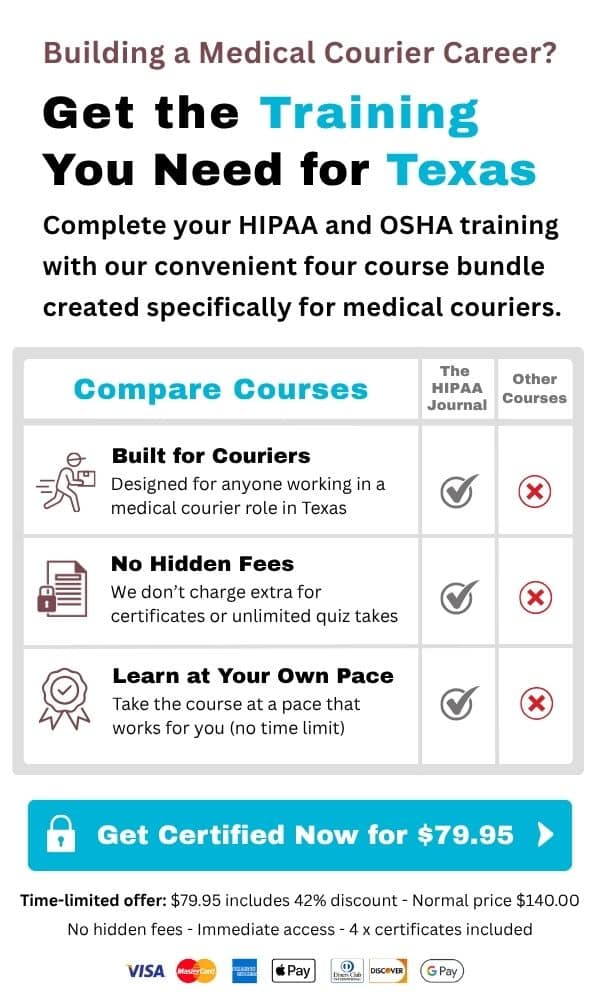
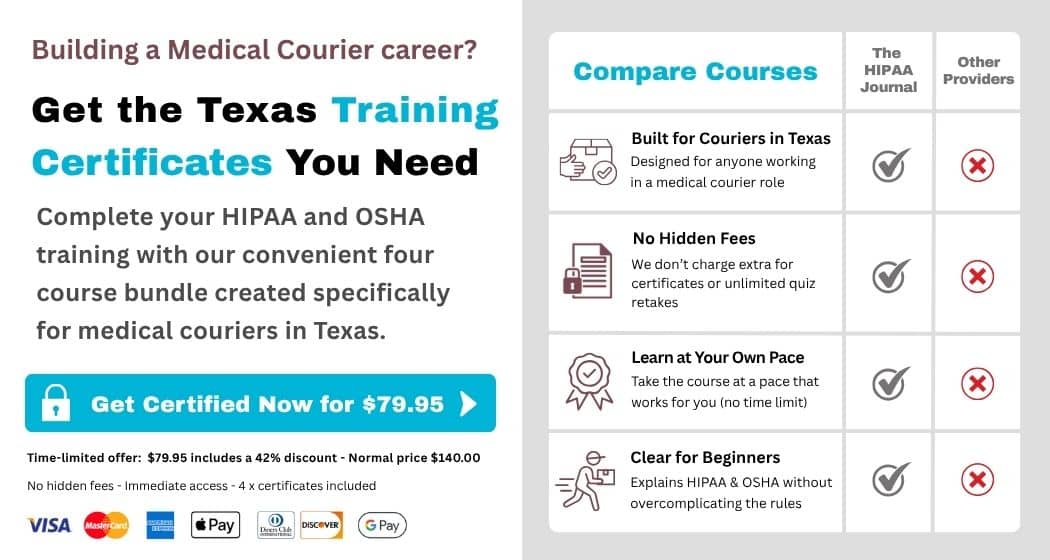
The HIPAA Journal’s Medical Courier Certification in Texas is structured to address all three requirement areas in a single course bundle. The training includes HIPAA modules covering the Privacy Rule, Security Rule, and Breach Notification Rule, a Texas State Medical Privacy and Security Regulations module addressing HB 300, and OSHA modules covering Bloodborne Pathogens, Hazard Communication, and Personal Protective Equipment. The course is delivered online with pause-and-resume access, includes a short quiz after each lesson with unlimited retakes, and issues a certificate on completion that can be shared with healthcare clients or an employer as documented evidence that these requirements have been met.
 PJ Murray is the founder and publisher of The HIPAA Journal. He has more than 10 years of experience writing about HIPAA, healthcare compliance, patient privacy, and the protection of medical records. Through The HIPAA Journal, PJ helps healthcare organizations, business associates, and their employees better understand HIPAA regulations, reduce compliance risks, and strengthen the safeguards used to protect patient information.