
Becoming a medical courier in Texas requires meeting personal and business qualifications, providing a suitable vehicle and equipment, and completing training and certification that covers federal HIPAA rules, Texas medical privacy law under HB 300, and OSHA standards for handling blood, chemicals, and other regulated materials encountered during transport. Healthcare clients such as medical practices, laboratories, and hospitals generally expect a courier to meet all of these requirements before assigning delivery work involving Protected Health Information or biological specimens.
Compliance Topics a Texas Medical Courier Certification Must Cover
A courier working in Texas is responsible for meeting three distinct sets of compliance requirements at the same time. Federal HIPAA rules, Texas HB 300, and OSHA standards each address a different part of the role, and a courier who completes training in only one or two of these areas has not met the full scope of what Texas medical courier work requires.
Federal HIPAA Requirements for Medical Couriers
Federal HIPAA rules govern how Protected Health Information must be handled during pickup, transport, and delivery. A medical courier is typically a HIPAA Business Associate when transporting Protected Health Information on behalf of a healthcare provider, which brings the courier under the HIPAA Privacy Rule, Security Rule, and Breach Notification Rule. These rules apply regardless of the size of the courier operation or whether the courier works as an employee or an independent contractor. This training is mandatory under HIPAA law.
Texas HB 300 Requirements for Medical Couriers
Texas Health and Safety Code Chapter 181, known as HB 300, adds state-specific privacy obligations that apply in addition to federal HIPAA. HB 300 defines a covered entity more broadly than federal HIPAA, reaching any individual or organization that handles Protected Health Information in Texas regardless of federal HIPAA status, a definition that includes medical courier services. A courier who completes only general HIPAA training has not addressed the Texas-specific obligations HB 300 imposes, since Texas law is enforced separately by the Texas Attorney General. This training is mandatory under Texas law.
OSHA Requirements for Medical Couriers
OSHA standards apply separately, since courier work can involve exposure to blood, bloodborne pathogens, and hazardous chemicals during handling and transport. Bloodborne Pathogens (BBP) standards apply when a courier handles blood or blood samples. BBP training is mandatory under federal law. Hazard Communication standards apply when a courier transports chemicals. Personal Protective Equipment standards govern the selection and proper use of protective gear appropriate to the materials being handled. These requirements address physical safety and apply independently of a courier’s HIPAA or HB 300 compliance status.
Age Requirements
Most medical courier companies require a driver to be at least 18 years old, though some companies and insurance policies set the minimum age at 21. The applicable minimum depends on the specific company’s hiring policy and the terms of its auto insurance coverage, so a prospective courier should confirm the age requirement directly with the company or client before applying.
Driver’s License and Driving Record
A medical courier in Texas needs to hold a valid Texas driver’s license and maintain a clean driving record. Companies and clients typically look for no more than two moving violations within the past two to three years and no DUI convictions within the past five years. A driving record outside these limits can disqualify an applicant, since courier work depends on the consistent, reliable transport of time-sensitive and regulated materials.
Vehicle and Insurance Requirements
A medical courier needs to provide a reliable, fuel-efficient vehicle, such as a sedan, SUV, or van, suitable for transporting specimens, records, and other materials without delay. Active auto liability insurance is required, and independent contractors are often required to carry higher coverage limits than a standard personal policy provides, such as $100,000 per person and $300,000 per accident in bodily injury coverage. A courier working through a company should confirm the specific coverage limits that company or its clients require.
Technology Requirements
A medical courier needs a reliable smartphone with GPS and mobile data to support real-time tracking applications used by courier companies and their healthcare clients. This technology allows dispatch staff and clients to monitor delivery status and confirm chain of custody for time-sensitive materials.
Equipment for Safe Transport
Medical courier work requires equipment suited to the materials being transported. Insulated cooler bags and ice packs are needed for temperature-sensitive specimens that must be kept within a specific range during transport. Tamper-proof transport bags and biohazard spill kits are needed for materials that require secure handling and a documented chain of custody. Personal protective equipment, including disposable gloves, is needed to reduce the risk of exposure when handling blood, specimens, or other regulated materials.
Completing Medical Courier Certification in Texas
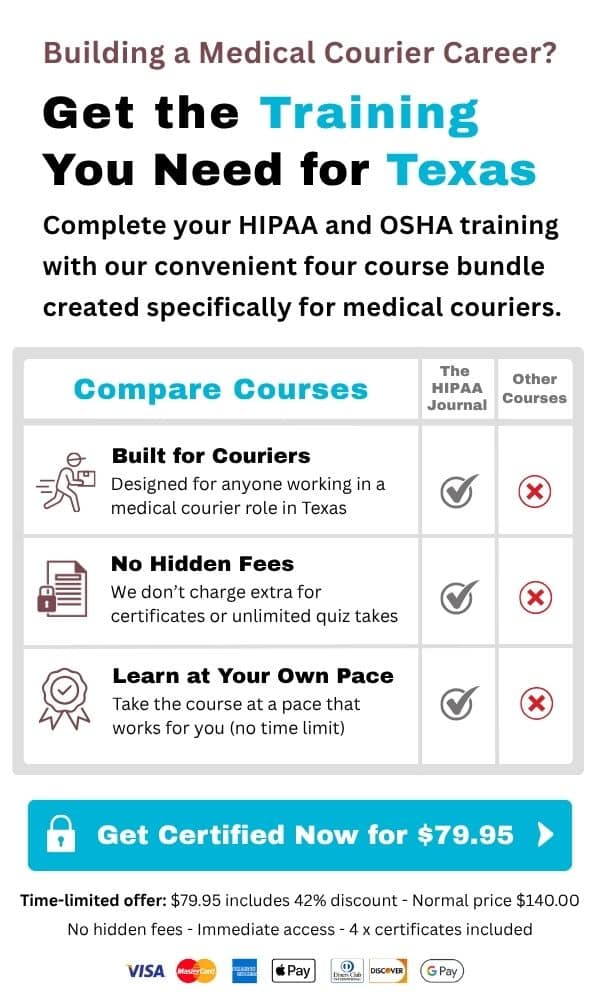
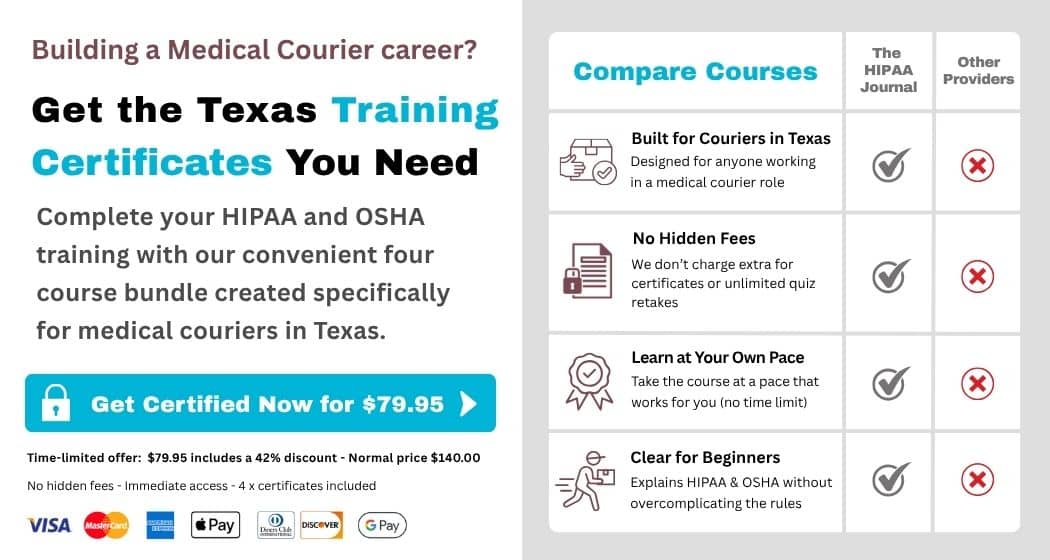
The HIPAA Journal’s Medical Courier Certification in Texas combines these requirements into a single online course bundle. Certification is completed in four steps.
- Access the training on any device, including a mobile phone, laptop, desktop, or tablet.
- Complete the lessons on an individual schedule, using pause-and-resume access rather than a fixed session length.
- Pass a short quiz at the end of each lesson, with unlimited retakes available until a passing score is reached.
- Download or print the certificate once all lessons and quizzes are complete.
What The Texas Medical Courier Certification Course Covers
The bundle includes HIPAA training addressing the HIPAA Privacy Rule, HIPAA Security Rule, and HIPAA Breach Notification Rule as they apply to courier work, along with a Texas State Medical Privacy and Security Regulations module covering HB 300 and related state laws. Three OSHA modules are included as well, covering Bloodborne Pathogens, Hazard Communication, and Personal Protective Equipment.
Operating as an Independent Contractor in Texas
A medical courier who plans to operate an independent courier business rather than work as an employee of a courier company needs to register a business entity, such as an LLC, obtain an Employer Identification Number, and open a business bank account. Operating under this structure allows an independent courier to contract directly with healthcare clients as a 1099 contractor, and clients evaluating an independent contractor will generally expect the same driving record, vehicle, insurance, equipment, and certification requirements described above to be in place before assigning work.
 PJ Murray is the founder and publisher of The HIPAA Journal. He has more than 10 years of experience writing about HIPAA, healthcare compliance, patient privacy, and the protection of medical records. Through The HIPAA Journal, PJ helps healthcare organizations, business associates, and their employees better understand HIPAA regulations, reduce compliance risks, and strengthen the safeguards used to protect patient information.