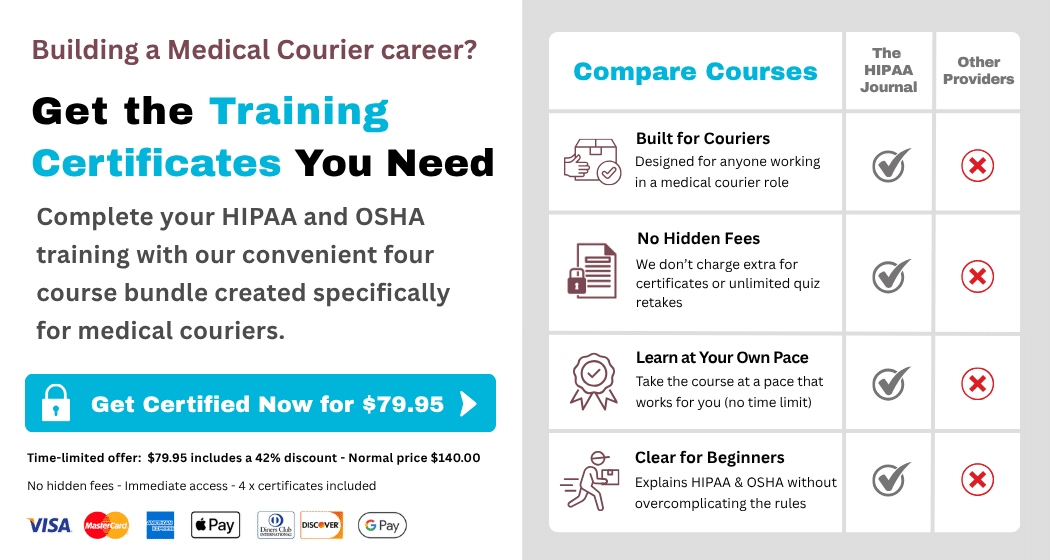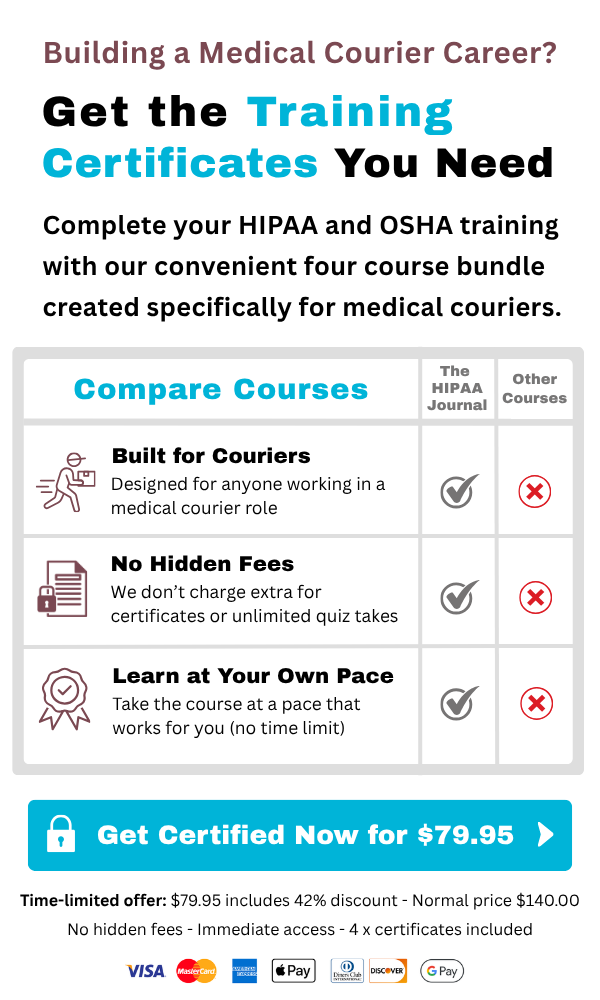

The best choice for courier HIPAA certification is an online course that delivers instruction through realistic scenarios drawn from documented compliance failures, confirms comprehension through lesson-by-lesson assessment, and issues a verifiable certificate that covered entity clients and courier employers accept as proof of documented compliance training. Medical couriers qualify as HIPAA Business Associates or regulated subcontractors in all circumstances where they transport Protected Health Information for a covered entity, and that classification creates direct, enforceable compliance obligations for every individual in the courier workforce.
Annual Training Recommended
Annual HIPAA training is the accepted industry best practice, and a certification program that supports annual renewal ensures that individual couriers maintain a current compliance record rather than a historical credential that no longer reflects current regulatory requirements. For medical courier companies with multiple staff members, The HIPAA Journal’s HIPAA Training for Medical Courier Employees is the best choice for courier HIPAA certification because it was developed by the leading source of HIPAA compliance reporting, delivers HIPAA Business Associate-specific content through realistic scenarios drawn from more than a decade of breach analysis.
Medical Couriers are HIPAA Business Associates
A HIPAA certification course built for covered entity workforces does not prepare a courier for the compliance obligations that arise from HIPAA Business Associate status. Courier staff must understand what their employer’s Business Associate Agreement requires of them individually, how the HIPAA Minimum Necessary Rule restricts their access to PHI to what is required to complete the delivery function, and what incident reporting obligations flow contractually to the covered entity when a security event occurs during collection, transport, or delivery. A certification course that addresses HIPAA in the covered entity context without covering these distinctions leaves a courier with a credential that does not reflect the compliance environment they actually work in.
HIPAA Certification for Solo Medical Couriers
For an individual courier, HIPAA Certification for Medical Couriers provides documented proof of compliance readiness that covered entity clients and courier employers require before granting facility access or allowing contact with PHI-containing materials. A certified courier removes a verification step that can otherwise delay onboarding and satisfies vendor credentialing requirements without waiting for employer-arranged group training. For couriers working as independent contractors or subcontractors, personal certification is often the documentation that upstream Business Associates require before PHI can be disclosed for a contracted service, making certification a practical prerequisite for operating in the healthcare logistics sector.
FAQs About Enrolling in HIPAA Medical Courier Training
The following questions answer many of the issues associated with HIPAA certification of medical couriers.
Can I enroll in HIPAA medical courier training online?
Yes. The HIPAA Journal’s HIPAA medical courier training is available online and can be completed on a mobile phone, laptop, desktop, or tablet.
How long does the course take?
The course takes about 30 minutes and can be completed in one sitting or across multiple sessions.
Do I receive a certificate?
Yes. A certificate is issued immediately after the required lessons and quizzes are completed successfully.
Is HIPAA medical courier certification official?
There is no official government-issued HIPAA certification for medical couriers. The certificate documents completion of training from a private training provider. The objective is to satisfy the training requirements of hospitals and clinics that use the services of medical couriers. The HIPAA certificate from The HIPAA Journal is the best available as proof that a medical courier has received HIPAA training.
Do self-employed medical couriers need HIPAA training?
Self-employed medical couriers need HIPAA training when healthcare clients require proof that they understand how to protect PHI during collection, transport, delivery, documentation, and incident reporting. It is standard industry practice for HIPAA-Covered Entities to require that medical couriers understand their responsibilities regarding HIPAA and OSHA.
Does HIPAA training make a courier company HIPAA compliant?
HIPAA training is one part of HIPAA compliance. Courier companies may also need appropriate policies, procedures, safeguards, to sign Business Associate Agreements provided by the clients, understand the incident reporting processes, and keep documentation.
 PJ Murray is the founder and publisher of The HIPAA Journal. He has more than 10 years of experience writing about HIPAA, healthcare compliance, patient privacy, and the protection of medical records. Through The HIPAA Journal, PJ helps healthcare organizations, business associates, and their employees better understand HIPAA regulations, reduce compliance risks, and strengthen the safeguards used to protect patient information.