
Every member of a covered entity’s workforce must receive HIPAA training, including clinical staff, administrative personnel, billing teams, IT and security staff, volunteers, students on placement, temporary employees, and management at every level, because the HIPAA Privacy Rule requires training for all workforce members handing medical records and the HIPAA Security Rule at 45 CFR §164.308(a)(5) mandates a security awareness and training program for all workforce members including management. The obligation does not distinguish between full-time and part-time employees, between clinical and non-clinical roles, or between permanent staff and those engaged on a temporary or volunteer basis. Any individual who works under the direct control of the covered entity and whose activities could affect the privacy or security of Protected Health Information falls within the workforce definition and therefore within the training requirement.
Why Non-Clinical Staff Are Included
A common misconception is that HIPAA training applies primarily to clinicians and staff who directly handle patient records. Administrative staff who schedule appointments, billing personnel who process insurance claims, IT employees who maintain systems containing electronic PHI, and facilities staff who access areas where PHI is stored or displayed all interact with the compliance environment that HIPAA governs. A receptionist who discusses a patient’s appointment in a public area, a billing analyst who emails a claims file to the wrong recipient, or an IT technician who misconfigures access controls on a system containing PHI can each produce a HIPAA violation regardless of whether their role is clinical. The scope of the training obligation reflects the scope of the compliance risk, which extends across the entire workforce.
Management and Leadership
The HIPAA Security Rule’s explicit inclusion of management in the security awareness training requirement reflects the compliance risk that senior personnel represent when they hold elevated system access, approve exceptions to security policies, or make operational decisions without a working understanding of the HIPAA implications. Leadership staff who are exempt from training requirements that apply to everyone else undermine the consistency of the compliance program and create exploitable gaps in the organization’s security posture.
Recommended HIPAA Training for Covered Entity Staff
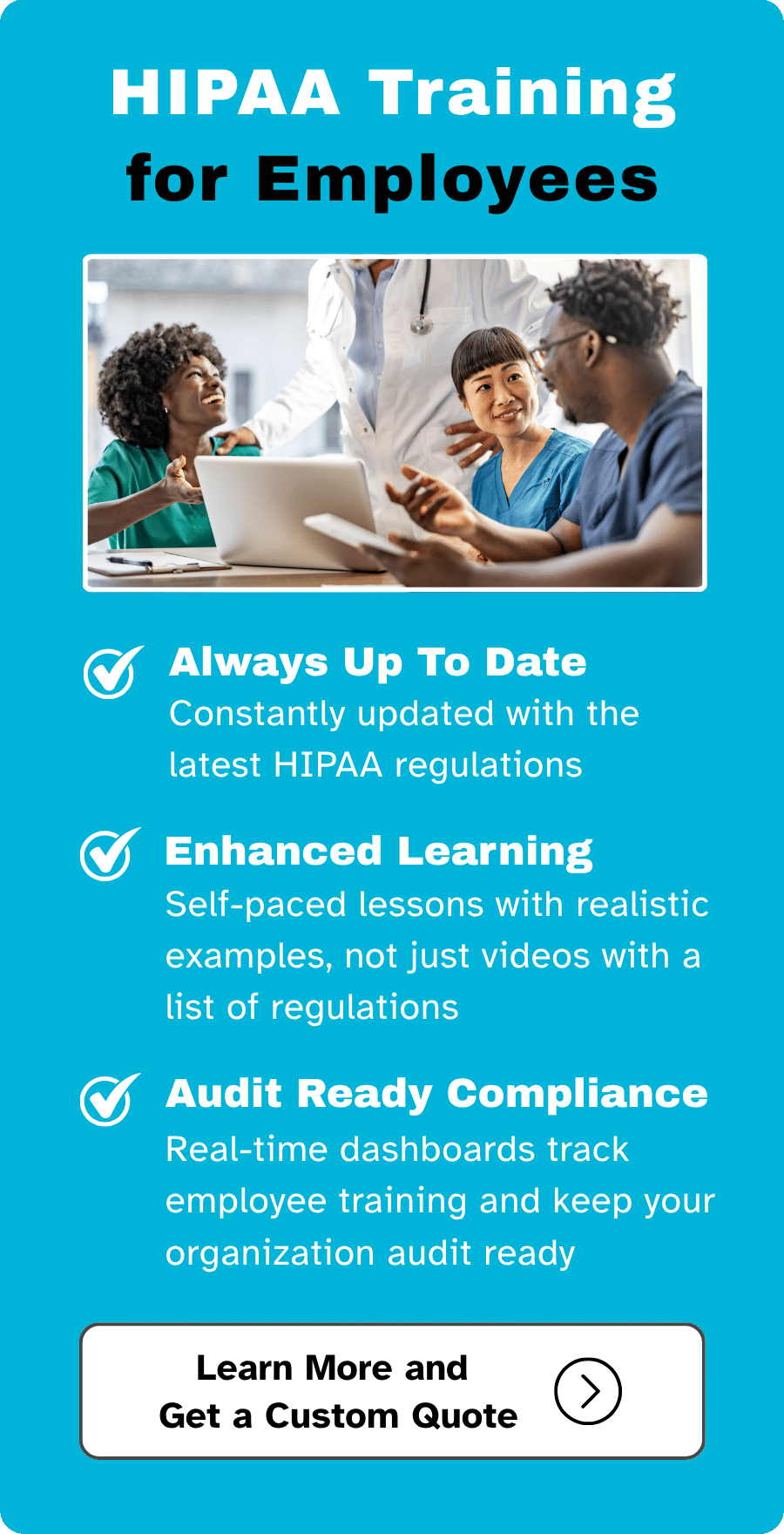
The HIPAA Journal’s HIPAA Training for Employees is an online course satisfying HIPAA training requirements regarding HIPAA rules and regulations for covered entities of every size, from small medical practices to large hospital systems, and suitable for new hire onboarding and annual refresher training across all staff categories. Built on more than a decade of breach reporting and enforcement analysis, the course presents realistic scenarios drawn from documented incidents, covering the HIPAA Privacy Rule, HIPAA Security Rule, and HIPAA Breach Notification Rule before advancing to content on generative AI, social media, and state-specific requirements for California and Texas. Randomized lesson-by-lesson assessments confirm comprehension after each module, unlimited retakes are included, and completion certificates are issued automatically. A real-time administration dashboard gives compliance managers current visibility into training completion across every workforce category, maintaining audit-ready records without manual administration. The course is accessible from any device and is available in SCORM format for organizations operating their own learning management systems.