
Medical couriers are required to hold HIPAA training and OSHA certifications that corresponds to the materials they transport, including Bloodborne Pathogens (BBP) certification for blood sample handling, Hazard Communication (HazCom) certification for chemical or reagent handling, and Personal Protective Equipment (PPE) certification for use of gloves, gowns, or other protective gear. HIPAA training addresses the handling and disclosure of protected health information encountered during transport.
The HIPAA certification required for medical couriers is a documented certificate of completion from an accredited training course that covers the HIPAA Privacy Rule, HIPAA Security Rule, and HIPAA Breach Notification Rule as they apply to courier operations, and that confirms the courier understands what information is protected under HIPAA, how to protect it during transport and handling, and how to respond when an impermissible disclosure occurs. No federal licensing body issues HIPAA credentials, and no government exam confers certification. The certificate that clients and employers ask for is proof that the courier completed a structured training program from a recognized provider before accessing or transporting protected health information. The quality and accreditation status of that certificate determines whether it satisfies the expectations of healthcare clients, staffing agencies, and courier company compliance programs.
Why Healthcare Clients Require HIPAA Certification from Couriers
Medical courier services qualify as HIPAA Business Associates when they transport protected health information on behalf of a Covered Entity. That classification carries compliance obligations under the Security Rule, including the requirement to implement administrative, physical, and technical safeguards appropriate to the information handled during courier operations. One of the administrative safeguard requirements is a documented workforce training program. Healthcare clients request proof of HIPAA certification from couriers as part of their own compliance program, because they must be able to demonstrate that their Business Associates have trained workforces before PHI is transferred to them.
| Material Handled by a Medical Courier | Related HIPAA Safeguard Consideration |
|---|---|
| Specimens | Labels and accompanying paperwork can contain patient identifiers, requiring chain-of-custody handling consistent with the HIPAA Privacy Rule. |
| Manifests | Route manifests can list patient names and delivery details, requiring restricted access limited to individuals with a legitimate need for the information. |
| Delivery Records | Signed delivery confirmations can contain protected health information, requiring secure storage and retention consistent with employer recordkeeping procedures. |
| Tracking Data | Electronic tracking systems that log package and patient information fall under HIPAA Security Rule safeguards for electronic protected health information. |
| Mobile Devices and Communication Tools | Phones, tablets, or scanners used for dispatch and delivery confirmation require device safeguards addressed in HIPAA Security Rule training. |
No Contracts without HIPAA and OSHA Certification
A courier who cannot produce a HIPAA and OSHA certificate when asked by a healthcare client, staffing coordinator, or dispatch company faces a practical barrier to contract assignment. Many healthcare facilities require proof of training at the point of credentialing, before a courier is cleared to access the facility or pick up specimens, records, or pharmaceutical materials. That requirement exists independently of any contract negotiation and applies whether the courier is employed by a courier company or operating as an independent contractor.
What the Certificate Must Demonstrate
A certificate that satisfies client and employer requirements reflects completion of training that addressed the three HIPAA rules in sufficient depth for the courier to apply them in operational settings and the required OSHA training. A certificate from a course that provides only a brief introduction to healthcare privacy, without covering the HIPAA Security Rule safeguard obligations that apply to Business Associates or the breach reporting procedures that govern impermissible disclosures, does not meet the same standard as a certificate from an accredited course that covers all three rules through job-relevant scenarios.
The HIPAA Journal’s HIPAA Certification for Medical Couriers carries accreditation through the Compliance Certification Board, which is recognized in the healthcare compliance field. The certificate issued upon completion is verifiable by employers and healthcare clients through a dedicated verification service, which means a client can confirm a certificate’s authenticity without relying solely on the courier’s own documentation.
The Regulatory Basis for HIPAA Training in Courier Operations
HIPAA Privacy Rule Training: Mandatory for Medical Couriers
The HIPAA Privacy Rule at 45 CFR 164.530(b) requires that HIPAA training be provided to all workforce members as necessary and appropriate to carry out their functions. For medical courier workforces, that standard includes instruction on how to handle materials that contain or reference patient information, what constitutes an impermissible disclosure in a courier context, how to respond to a lost or misdelivered package containing PHI, and how to escalate a suspected breach through the correct internal channel. Training that covers only general privacy concepts without addressing these courier-specific scenarios does not satisfy the regulatory standard.
HIPAA Security Rule Training: May be Needed for Medical Couriers
The HIPAA Security Rule at 45 CFR 164.308(a)(5) requires HIPAA Business Associates to implement a security awareness and training program for all workforce members. Medical courier companies that qualify as HIPAA Business Associates are subject to this requirement for every person in their workforce whose role involves any contact with protected health information, including drivers who transport specimens, dispatchers who manage manifests containing patient data, and supervisors who oversee chain-of-custody documentation. The training obligation is not limited to staff who directly access electronic systems. It applies to any workforce member whose function involves PHI in any form.
OSHA: Mandatory for Medical Couriers
OSHA certification requirements for medical couriers depend on the materials they handle during transport. Couriers who transport blood samples must complete Bloodborne Pathogens (BBP) certification under 29 CFR 1910.1030. Couriers who handle chemicals, reagents, or labeled hazardous materials must complete Hazard Communication (HazCom) training under 29 CFR 1910.1200. Couriers whose duties involve gloves, gowns, or other protective gear must complete Personal Protective Equipment (PPE) training under 29 CFR 1910.132. The combination of certifications required for a given courier depends on the scope of work assigned by each client.
Individual Couriers and Pre-Employment Certification
Independent couriers and individuals applying for positions with healthcare clients or courier companies often need to obtain certification before an offer is extended or an assignment begins. Pre-employment HIPAA and OSHA certification demonstrates to a prospective client or employer that the courier has already received foundational instruction on the rules governing PHI handling, which reduces the onboarding burden and satisfies the training documentation requirement before route assignments begin.
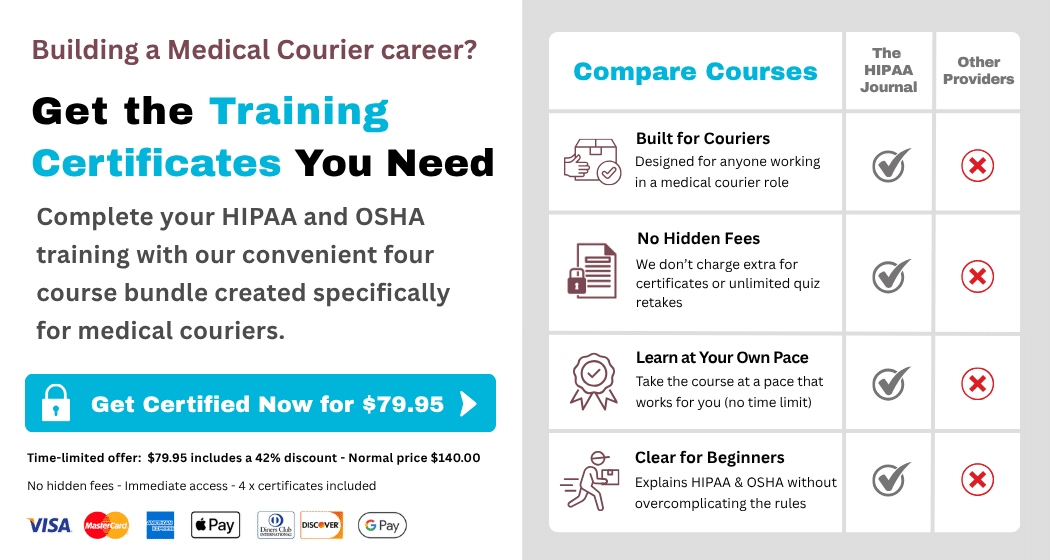
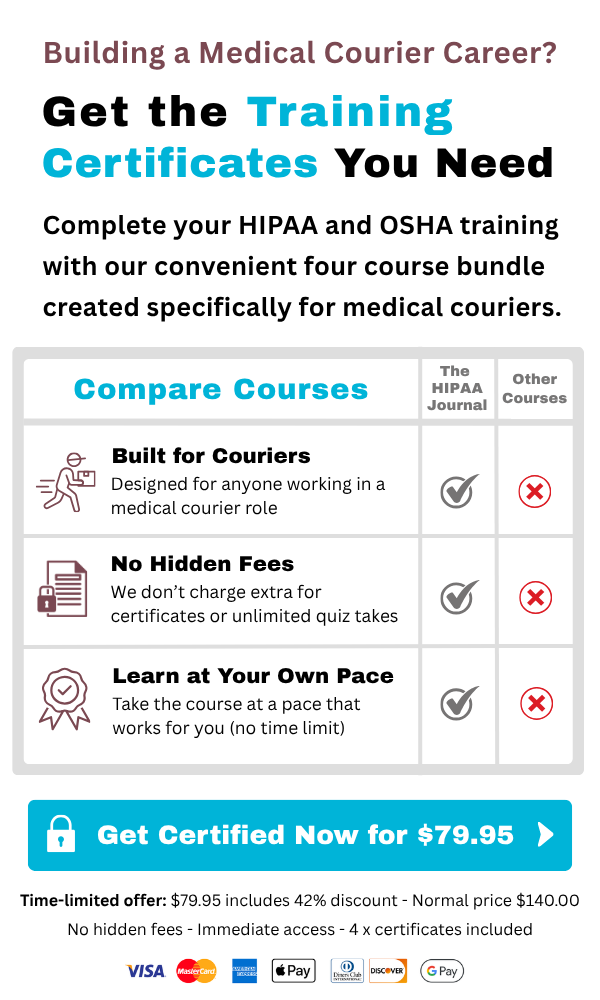
The HIPAA Certification for Medical Couriers course from The HIPAA Journal is structured for individual purchase and self-directed completion. The course takes approximately 30 minutes, is accessible on any device including mobile phones, and issues the accredited certificate immediately after all mandatory modules and lesson quizzes are completed. Unlimited quiz retakes are included at no additional charge. The all-inclusive price covers the certificate, the verification service, and the supplementary modules available after mandatory training is finished. Medical couriers in Texas require additional HB 300 training and therefore need medical courier certification adapted to Texas.
HIPAA and OSHA Certification for Medical Couriers from The HIPAA Journal
The HIPAA Journal’s HIPAA Certification for Medical Couriers is an accredited online course suitable for pre-employment verification, employer onboarding, and annual refresher training. The curriculum addresses the HIPAA Privacy Rule, Security Rule, and Breach Notification Rule through scenarios drawn from documented compliance patterns in courier and healthcare transport settings, connecting the federal rules to the operational decisions couriers make during pickup, transport, delivery, and documentation. The certificate is issued immediately after completion and is verifiable by healthcare clients and employers through The HIPAA Journal’s certificate verification service.
 PJ Murray is the founder and publisher of The HIPAA Journal. He has more than 10 years of experience writing about HIPAA, healthcare compliance, patient privacy, and the protection of medical records. Through The HIPAA Journal, PJ helps healthcare organizations, business associates, and their employees better understand HIPAA regulations, reduce compliance risks, and strengthen the safeguards used to protect patient information.