
You get HIPAA certified as an individual by purchasing an accredited HIPAA certification course, creating a learner account, completing the required HIPAA training modules and lesson quizzes, and then downloading the certificate that is issued immediately after successful completion.
What Individual HIPAA Certification Represents
Individual HIPAA certification is documentation that you completed HIPAA training and demonstrated knowledge through assessment. It does not create an independent legal status under HIPAA and it does not substitute for an employer’s compliance program. Employers use certificates to document onboarding and ongoing training completion for workforce members who handle protected health information. Training on HIPAA rules and regulations provides baseline understanding before an employer assigns internal policies, procedures, and operational expectations.
Accredited HIPAA Certification from The HIPAA Journal
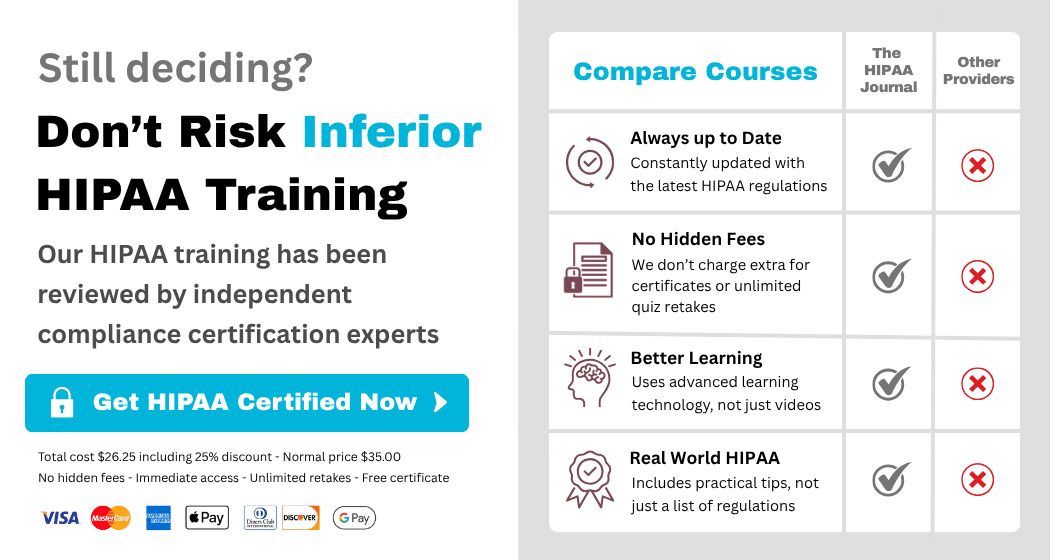
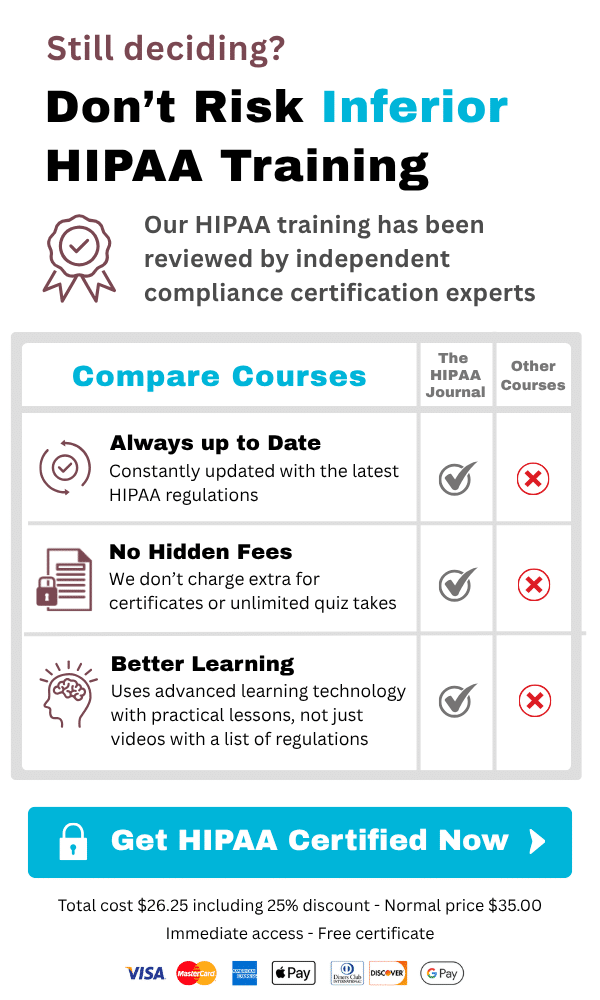
The HIPAA Journal offers an online Accredited HIPAA Certification delivered through a learning management system that is accessible on demand from desktop computers, mobile phones, and tablets. The course is presented as an accredited certificate course with 5.0 continuing education units and is described as an all-inclusive purchase with certificate download and certificate verification available for employers or hiring agencies.
The course curriculum is structured as mandatory modules with a multiple-choice quiz after each module, plus additional reference and advanced modules that are available after you complete the mandatory learning and receive the certificate. The mandatory content covers the HIPAA Privacy Rule, HIPAA Security Rule, and HIPAA Breach Notification Rule and applies those requirements to workplace conduct and disclosure decisions involving protected health information. It includes topics addressing device, credential, and email security for electronic protected health information and includes content on emerging issues such as the use of generative AI tools and social media. Optional modules are available for learners who work in states with additional medical privacy and security requirements, including HIPAA compliance training for Texas and HIPAA compliance training for California.
Four Step Process to Receive Your Certificate
Step 1 is accessing the HIPAA training course on any device, including a mobile phone, laptop, desktop, or tablet.
Step 2 is using pause-and-resume controls to complete the lessons around your own personal schedule.
Step 3 is completing a short quiz at the end of each lesson, with unlimited retakes until you achieve a passing score. There is no exam at the end of the course, you pass the quiz tests during the training course.
Step 4 is receiving the HIPAA certificate immediately after you complete the training and pass the quizzes, which supports applications and onboarding documentation.
Time to Complete the Course
The course is described as approximately 40 minutes and it can be completed in one sitting or lesson-by-lesson using pause-and-resume controls. Your total time can increase if you retake lesson quizzes or if you split the training across multiple sessions.
Certificate Verification and Training Records
The certificate can be verified through a verification process in which confirmation is sent to an email address you specify. If an employer requests proof of training, retain your HIPAA training certificate and the completion date associated with the certificate.
OSHA Training for Individuals
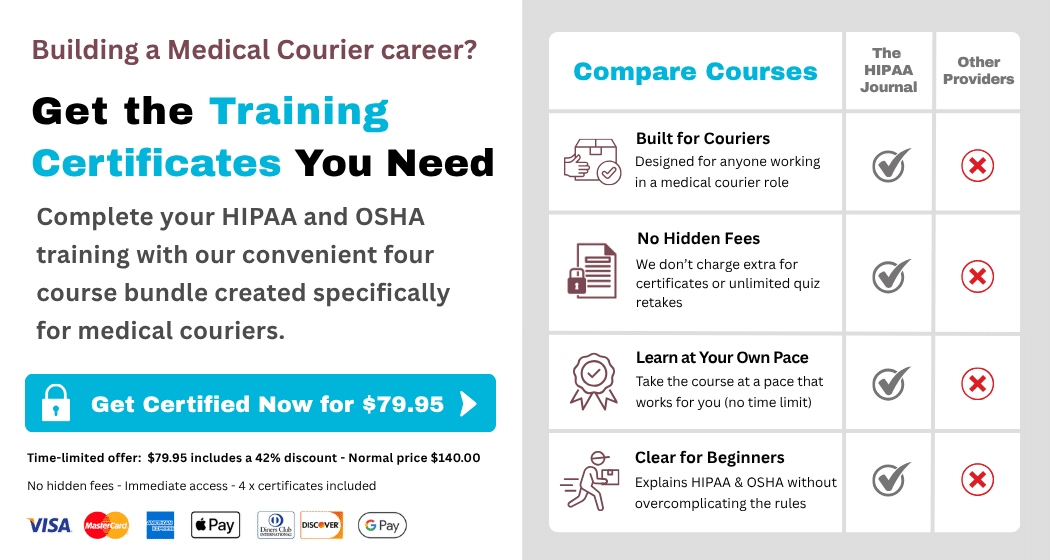
Individuals whose work involves exposure to blood, hazardous chemicals, or other workplace hazards in healthcare settings may require OSHA training in addition to HIPAA certification, and the OSHA training is completed as a separate course with its own certificate. HIPAA training addresses the handling of protected health information. OSHA training addresses the physical safety of the individual performing the work. Healthcare employers, laboratories, pharmacies, and hospitals commonly request both certificates during hiring and contracting.
What Individual OSHA Certification Represents
OSHA does not issue a certification to individuals for the Bloodborne Pathogens, Hazard Communication, or Personal Protective Equipment standards. An OSHA training certificate is documentation that the learner completed training on the requirements of a specific OSHA standard and passed the associated assessments. OSHA standards place training obligations on employers. An individual certificate records prior training that an employer or client can review. The employer must still provide training on its own exposure control plan, written hazard communication program, and PPE hazard assessment.
OSHA Standards That Apply to Healthcare Support Roles
Three OSHA standards apply to individuals who transport or handle specimens, chemicals, and medical materials. The Bloodborne Pathogens Standard at 29 CFR 1910.1030 applies to workers with reasonably anticipated occupational exposure to blood or other potentially infectious materials. Training is required at initial assignment and at least annually thereafter.
The Hazard Communication Standard at 29 CFR 1910.1200 applies to workers who may be exposed to hazardous chemicals such as dry ice, formalin, laboratory reagents, and disinfectants. Training covers labels, Safety Data Sheets, and the physical and health hazards of the chemicals in the work area. It is required at initial assignment and whenever a new chemical hazard is introduced.
The Personal Protective Equipment Standard at 29 CFR 1910.132 applies to workers who must use gloves, eye protection, or protective clothing. Training covers when PPE is required, how to put it on and remove it, its limitations, and its care and disposal. The worker must demonstrate an understanding of the training before performing work that requires PPE.