
HIPAA certification is generally treated as current for 12 months, which reflects the annual retraining standard that healthcare organizations, Business Associates, and compliance programs apply when maintaining documented workforce training records, and the HIPAA Journal’s Accredited HIPAA Certification supports that cycle by providing 12 months of course access after purchase, updated modules when regulations change, and access to additional training materials after the certificate has been issued. No federal regulation specifies a fixed expiration date for a HIPAA training certificate, and HHS has not established a universal renewal period. The 12-month standard exists because the regulations, enforcement guidance, and operational risks that underpin HIPAA compliance change over time, and a certificate that accurately represented a workforce member’s knowledge at one point in the year may not reflect current regulatory requirements or organizational policy twelve months later.
What the 12-Month Access Period Provides
The Accredited HIPAA Certification from The HIPAA Journal provides 12 months of course access from the date of purchase. That access period extends beyond the completion of the mandatory modules and the issuance of the certificate. A learner who completes the course and receives their certificate in the first week of the access period retains access to the full course content for the remaining eleven months. That allows the course to function as a reference resource during the year rather than a one-time completion event with no subsequent value.
Updated HIPAA Training
When regulatory changes occur during the access period, updated training modules are made available through the course platform. A learner with an active access period can review those updates without purchasing a new enrollment. That makes the course responsive to the actual compliance environment rather than static relative to the state of the regulations at the time of original purchase.
Additional Optional HIPAA Training Included
After completing the mandatory modules and receiving the accredited certificate, learners gain access to more than ten additional modules covering topics that the core certification modules do not address in depth. These include the use of generative AI tools in healthcare contexts, social media conduct involving patient data, the consequences of HIPAA violations for individuals and organizations, how HIPAA applies during emergency situations, and the roles and responsibilities of Privacy and Security Officers. Those modules remain accessible throughout the 12-month period and can be completed in any order at any time after the certificate has been issued.
How Employers Use the 12-Month Standard
Organizations that assign HIPAA training to their workforces typically set a 12-month renewal cycle to align training records with their annual compliance review calendar. Under that structure, a workforce member whose certificate was issued in a given month is scheduled for refresher training within 12 months of that date. The employer retains the completion record from each annual cycle to satisfy the six-year documentation retention requirement under 45 CFR 164.530(j) and 45 CFR 164.316(b).
HIPAA Business Associates
For medical courier companies and other Business Associates that must demonstrate compliant workforces to healthcare clients during Business Associate Agreement negotiations or contract renewals, the age of the training certificate can affect the outcome of client credentialing reviews. A certificate issued within the past 12 months signals an active and current training program. A certificate that is two or three years old raises questions about whether the organization’s training program is functioning as required and whether the workforce member’s knowledge reflects the current regulatory framework.
Healthcare staffing agencies and credentialing bodies that accept HIPAA certification as a pre-employment or facility access requirement typically specify a maximum certificate age, and 12 months is the most common threshold. A courier, clinician, or administrative worker presenting a certificate from more than 12 months ago may be required to recertify before an assignment begins, regardless of whether the certificate itself carries an expiration date from the issuing provider.
Annual Refresher Training and the Certification Cycle
Annual refresher training serves a different function than first-time certification. A workforce member completing initial HIPAA training is building a foundational understanding of the rules and their application. A workforce member completing annual refresher training is updating that understanding to account for regulatory amendments, enforcement developments, changes to the organization’s internal policies, and any compliance events that occurred during the prior year that revealed knowledge gaps or procedural weaknesses in the workforce.
Refresher training content should not simply repeat the original certification material. Where the regulatory environment has changed, the training must address those changes directly. Where an organization’s policies have been revised, the training must connect the revised policies to the federal rules that require them. Where a compliance incident or audit finding identified a specific knowledge gap in the workforce, the refresher training must address that gap with targeted instruction. Annual recertification through the same course supports the consistency and documentation requirements of the compliance program, but the value of refresher training comes from its responsiveness to what has actually changed during the prior year.
Accredited HIPAA Certification
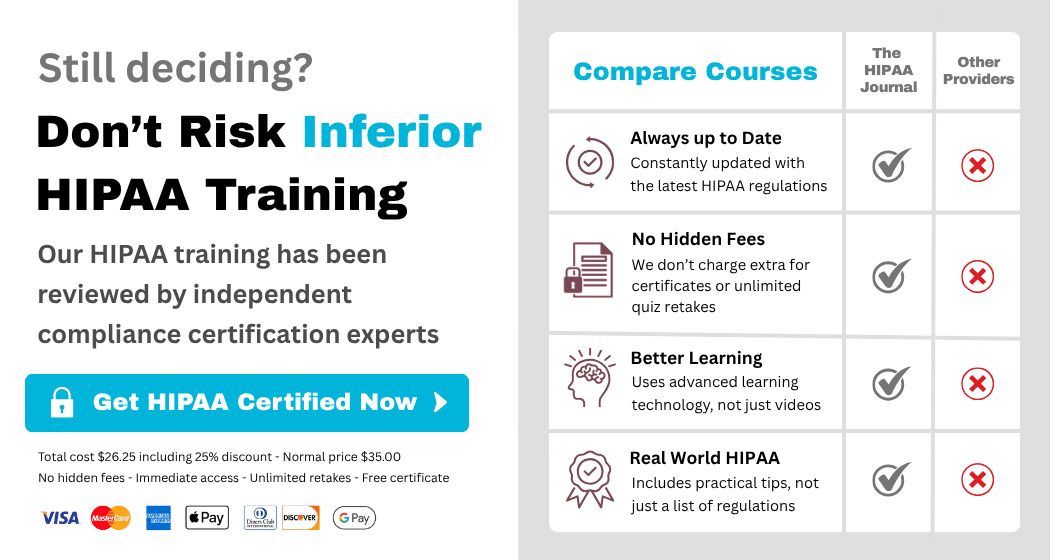
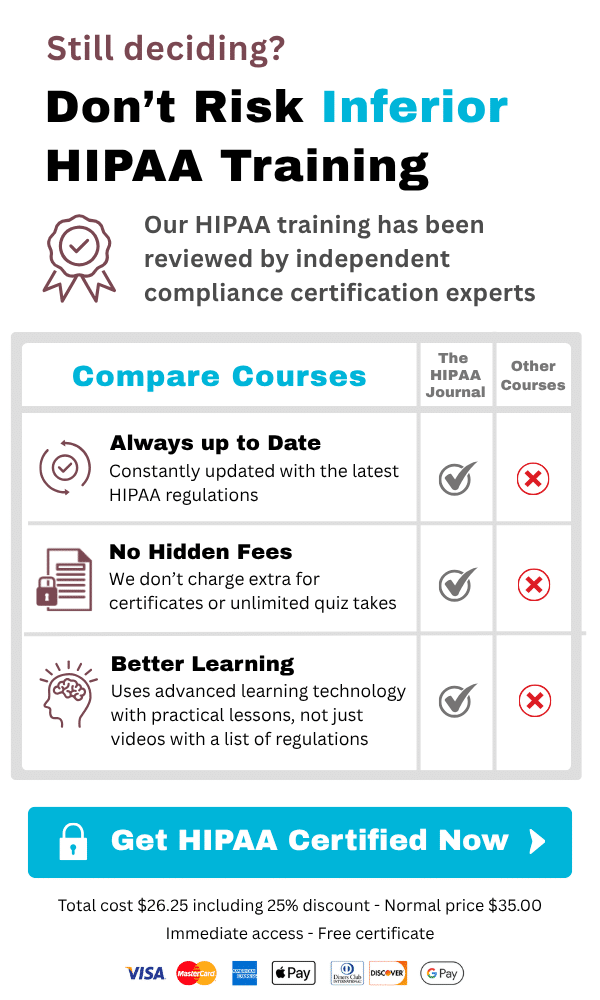
The HIPAA Journal’s Accredited HIPAA Certification is structured to support the full annual training cycle for individuals and organizations. The mandatory modules cover the Privacy Rule, Security Rule, and Breach Notification Rule through practical scenarios, each followed by a quiz with unlimited retakes and no final exam. The accredited certificate carrying 5.0 continuing education units from the Compliance Certification Board is issued immediately after all mandatory modules are completed. The 12-month access period, updated modules, and supplementary training library then remain available to the certificate holder through the remainder of the access period, supporting both the individual’s ongoing learning and the organization’s annual refresher requirement.