
Business associates use HIPAA training to win clients by demonstrating that their workforce understands how to handle protected health information in compliance with regulatory and contractual requirements, supported by documented training, certification, and consistent operational practices. Covered entities assess vendors based on their ability to safeguard data, and workforce training provides direct evidence of compliance readiness. Training ensures that employees understand how to manage protected health information across systems, apply safeguards, and follow procedures defined in HIPAA Business Associate Agreements. Organizations that can show structured training programs and verified workforce knowledge are better positioned during vendor evaluations and contract negotiations. The healthcare industry best practice is to provide HIPAA training annually to maintain workforce awareness and demonstrate ongoing compliance.
Workforce Competence and Client Evaluation
Healthcare organizations evaluate business associates based on their ability to protect protected health information across operational environments. Workforce competence is a measurable factor in this evaluation, and training provides the foundation for consistent handling of sensitive data. Employees must understand how to apply confidentiality, integrity, and availability standards when interacting with systems and workflows. Training ensures that staff can follow procedures, manage access appropriately, and respond to potential risks. Demonstrated workforce competence supports client decisions when selecting business associates for services involving protected health information.
Business Associate Agreements and Training Verification
HIPAA Business Associate Agreements may require HIPAA training and certification for all staff within the business associate organization. These agreements often include provisions that require documented evidence of workforce education as part of contractual compliance. Certification through training assessments provides verification that employees have completed instruction and understand regulatory requirements. Business associates that maintain training records and certification documentation can present this information during due diligence reviews. Meeting these contractual expectations supports client confidence and strengthens business relationships.
Operational Readiness Through Structured HIPAA Training
Business associates must show that their workforce can operate within environments that involve multiple entities, shared systems, and complex data flows. Training must address how protected health information moves across these environments and how responsibilities extend through upstream and downstream relationships. Employees must understand how to apply permitted uses and disclosures, follow the HIPAA Minimum Necessary Rule, and comply with the terms of business associate agreements. Instruction must also cover incident identification and reporting, including how to respond to both attempted and confirmed security events. This level of operational readiness demonstrates that the organization can manage protected health information in accordance with regulatory expectations.
The HIPAA Journal’s HIPAA Training for Business Associate Employees
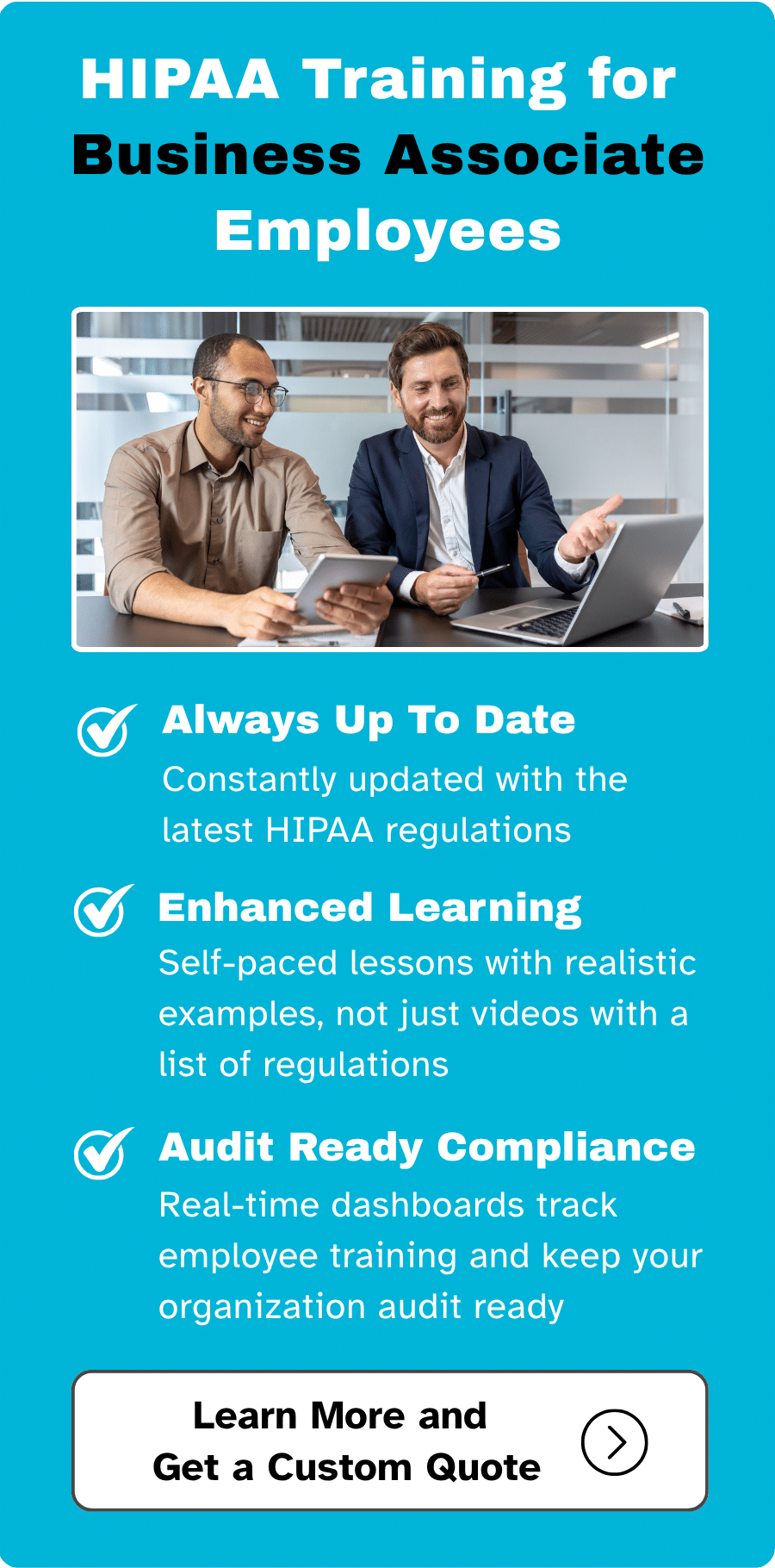
The HIPAA Journal’s HIPAA Training for Business Associate Employees provides a structured program designed to support business associates in meeting workforce training requirements and demonstrating compliance to potential clients. The program includes modules that explain how business associates function within the healthcare system, including their responsibilities for handling protected health information across multiple entities. It addresses permitted uses and disclosures, the application of safeguards under the HIPAA Security Rule, and the requirements defined in HIPAA Business Associate Agreements. The training includes scenario-based instruction that reflects real operational situations, helping employees understand how to apply compliance requirements in practice. It also covers incident reporting, patient rights considerations, and the consequences of noncompliance for both individuals and organizations. The program includes assessments that validate understanding and support certification, and it is delivered through an online platform that allows organizations to assign training, track completion, and maintain documentation for compliance purposes.
HIPAA Security Rule for Business Associates
Business associates strengthen client confidence and demonstrate operational security by implementing workforce-wide cybersecurity instruction that addresses how employees recognize threats, protect system access, and respond to incidents involving electronic protected health information. The HIPAA Security Rule requires organizations to implement a security awareness and training program for all workforce members with system access, which includes management and staff who may not directly handle medical records but still interact with systems containing sensitive data. The rationale for this requirement is that any individual with access to information systems represents a potential cybersecurity exposure due to risks such as credential compromise or phishing. Training must therefore address real attack methods and reinforce consistent behavior across the workforce. The HIPAA Journal’s Cybersecurity Training for Business Associate Employees provides a structured program that teaches staff how cyber threats occur in healthcare environments and how to prevent them through practical actions aligned with HIPAA requirements. The course includes instruction on identifying phishing attempts, securing credentials, and responding to suspicious activity, supported by real-world scenarios that reflect common attack methods such as weak passwords, unsafe device use, and delayed reporting. It is delivered as a self-paced program through an online platform, allowing organizations to assign training, monitor completion, and maintain documentation of workforce participation. This approach ensures that all employees, regardless of their role, understand how to reduce cybersecurity risk and support compliance when accessing systems that contain protected health information.
Business associates must maintain workforce awareness through regular training to ensure that compliance practices remain consistent over time. Annual training reinforces knowledge, updates employees on changes in policies or systems, and addresses new risks that may affect protected health information. Organizations that maintain consistent training schedules demonstrate a commitment to compliance and operational stability. This ongoing approach supports the ability to meet client expectations and maintain trust in handling sensitive data.