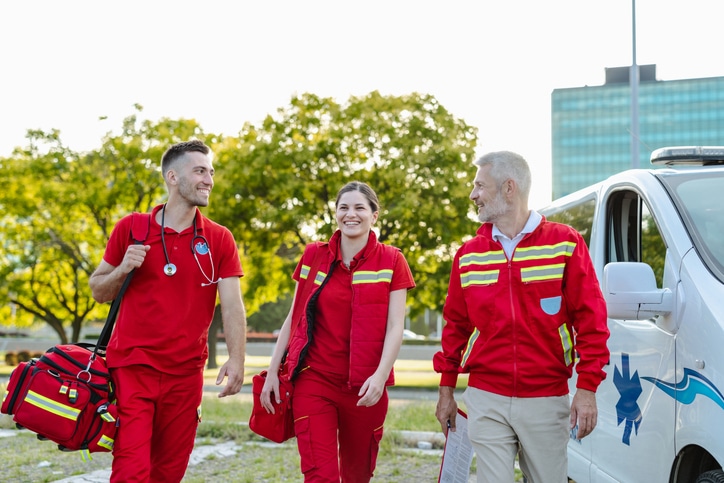
Paramedics and EMTs require HIPAA training covering the HIPAA Privacy Rule, HIPAA Security Rule, and HIPAA Breach Notification Rule, adapted to address how Protected Health Information is handled during patient assessment, transport, and the handoff process that defines prehospital emergency care. EMTs and paramedics occupy a unique position within the healthcare workforce because their entire scope of work happens outside a fixed clinical setting, often in a patient’s home, on a roadside, or inside a moving ambulance, where the conditions for documenting and sharing patient information differ substantially from a hospital or office-based practice. General HIPAA training built for stationary clinical environments does not fully address these conditions, which is why paramedics and EMTs benefit from instruction that accounts for the realities of prehospital care.
What Makes Prehospital HIPAA Compliance Distinct
Paramedics and EMTs generate Protected Health Information through patient care reports, vital sign monitoring equipment, and verbal reports delivered to receiving hospital staff, often while continuing to manage an active patient. The HIPAA Security Rule governs how this information must be protected on the mobile devices, tablets, and onboard systems used to document and transmit patient data during transport. The HIPAA Privacy Rule determines what may be shared and with whom, a question paramedics and EMTs face repeatedly as they move a patient from the field through multiple points of contact, including dispatch, receiving emergency department staff, and at times family members present at the scene.
Sharing Information During Treatment and Transport
The HIPAA Privacy Rule permits paramedics and EMTs, as members of one Covered Entity, to disclose Protected Health Information to staff at a different Covered Entity, such as emergency department personnel, for the purpose of organizing the patient’s ongoing treatment. This permission supports the verbal and written handoffs that occur at nearly every transport. Minimum necessary disclosures to public health agencies are also permitted, relevant in scenarios such as suspected infectious disease exposure or injury patterns that warrant public health surveillance. When a patient is unconscious, confused, or otherwise unable to grant permission, which paramedics and EMTs encounter regularly, the HIPAA Privacy Rule allows information to be shared with family members or others present in order to identify the patient or gather information relevant to treatment, based on the reasonable inference that the patient would not object under the circumstances.
Responding to Imminent Danger in the Field
Paramedics and EMTs frequently encounter situations involving an immediate threat to a patient or to others, such as signs of abuse, a credible statement of self-harm, or evidence of danger to bystanders. The HIPAA Privacy Rule permits a limited disclosure of Protected Health Information in good faith to any person or agency capable of averting that danger when the provider has actual knowledge of the threat, whether obtained directly or from a credible source at the scene. Training must reinforce that these disclosures, along with the reasoning behind them, need to be documented, and that any disclosure beyond what this provision allows requires a valid HIPAA authorization from the patient.
Training Designed for the Prehospital Setting
The HIPAA Journal’s HIPAA Training for Emergency Staff includes a HIPAA in Emergency Situations module that covers contingency planning, field-based disclosure permissions, imminent danger provisions, and enforcement discretion during widespread emergencies, delivered as part of the required Section One curriculum that leads to certification. EMS organizations operating in Texas or California can also add free optional state medical privacy modules at the time of purchase, which become part of the same required training for the entire agency.