
Healthcare organizations operating in California must satisfy both federal HIPAA training requirements and additional obligations imposed by California state law, making staff training in California more extensive than in most other states. HIPAA establishes a national baseline for protecting Protected Health Information, but California has enacted several statutes that go further, and workforce training must address both layers. Organizations that train staff only on HIPAA without accounting for California-specific law leave compliance gaps that state regulators can act on.
California Laws That Extend Beyond HIPAA
The Confidentiality of Medical Information Act (CMIA) imposes stricter consent and disclosure requirements than HIPAA on providers, health plans, and their contractors. Where the two regimes conflict, the more protective standard applies. Staff must understand not only HIPAA’s permitted uses and disclosures, but also where CMIA sets a higher bar, particularly around patient authorization and restrictions on sharing medical information. The California Consumer Privacy Act and its amendment, the California Privacy Rights Act (CCPA/CPRA), add consumer rights and transparency obligations that can apply to personal information your organization handles outside of direct clinical data, including website activity, marketing records, and employee data. The Patient Access to Health Records Act (PAHRA) and Medi-Cal confidentiality rules add further obligations depending on the services an organization provides. Training must make these distinctions concrete. Staff need to know which rule governs a given situation, what their obligations are under each, and who to contact when the answer is not clear.
| Law or Regulation | Requirements |
|---|---|
| HIPAA | Sets the federal baseline for medical privacy, establishing permitted uses and disclosures of protected health information, required safeguards, and breach notification obligations for Covered Entities and Business Associates. |
| Confidentiality of Medical Information Act (CMIA) | Imposes stricter consent and disclosure requirements than HIPAA on providers, health plans, and their contractors. Where the two regimes conflict, the more protective standard applies, particularly around patient authorization and restrictions on sharing medical information. |
| California Consumer Privacy Act and California Privacy Rights Act (CCPA/CPRA) | Adds consumer rights and transparency obligations that can apply to personal information an organization handles outside of direct clinical data, including website activity, marketing records, and employee data. |
| Patient Access to Health Records Act (PAHRA) | Adds obligations related to patient access to health records, applying depending on the services an organization provides. |
| Medi-Cal Confidentiality Rules | Add further confidentiality obligations that apply depending on the services an organization provides. |
HIPAA Training for Covered Entities and Their Staff
HIPAA Covered Entities in California must provide HIPAA training to all workforce members as required by the HIPAA Privacy Rule and the HIPAA Security Rule. The HIPAA Journal’s HIPAA Training for Employees course is structured to satisfy those obligations. The course addresses the root causes of HIPAA violations rather than rule summaries alone, drawing on over a decade of breach analysis to show staff the decision points where errors most often occur. Lessons cover the HIPAA Privacy Rule, HIPAA Security Rule, and HIPAA Breach Notification Rule, as well as device security, incident reporting, social media use, and the use of generative AI tools. A California-specific module covering state medical privacy regulations is available as an add-on and, when selected, becomes a required part of the course for all learners. Completion tracking, per-module assessments, and a certificate of completion support documentation requirements.
HIPAA Training for Individuals
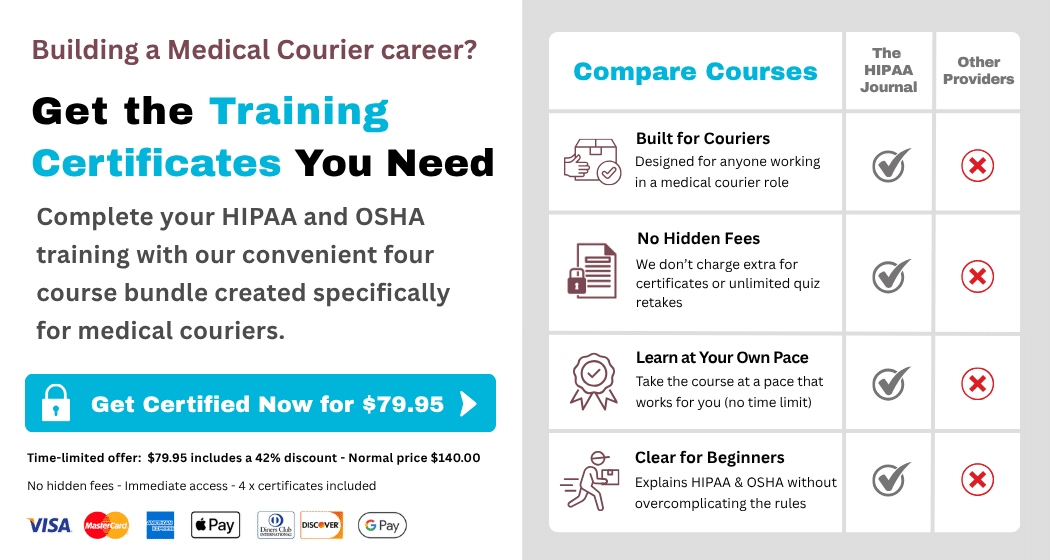
For individuals seeking accredited HIPAA training outside of an employer-provided program, The HIPAA Journal’s Accredited HIPAA Certification course covers the HIPAA Privacy Rule, HIPAA Security Rule, and HIPAA Breach Notification Rule with lesson-based quizzes and no final exam. The course is accessible on any device, supports pause-and-resume completion, and issues a verifiable certificate immediately on completion. A California state law module is included at no additional charge for learners who work in California. The training is suitable for new hires, job seekers, students, contractors, and vendor personnel who need documented HIPAA compliance training before or during onboarding.