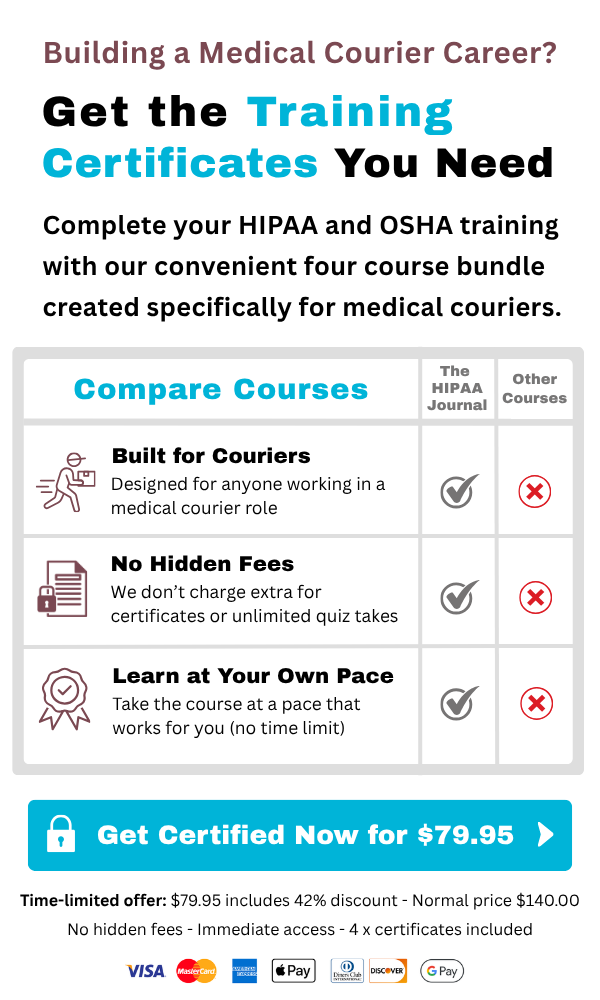

Adding HIPAA certification to a resume demonstrates to healthcare employers, staffing agencies, and contracting organizations that the applicant has completed formal instruction on the federal rules governing protected health information before beginning a role that involves access to patient data, records systems, or PHI-related workflows. Employers in clinical, administrative, billing, health IT, and healthcare vendor roles routinely request proof of HIPAA training as a pre-employment or onboarding condition, and a verifiable certificate from a recognized provider satisfies that requirement in a format that can be shared with hiring managers, added to professional profiles, and retained in workforce documentation. The HIPAA Journal’s Accredited HIPAA Certification is structured for exactly that purpose, providing individual learners with a course they can complete on any device at their own pace and a certificate issued immediately after all required modules and assessments are finished.
What Healthcare Employers Look for in HIPAA Certification
When a hiring manager or credentialing coordinator asks for HIPAA certification, they are looking for evidence of two things: that the applicant received structured instruction on the HIPAA Privacy Rule, HIPAA Security Rule, and HIPAA Breach Notification Rule, and that the instruction came from a provider whose certificate carries enough standing to be accepted without question. A certificate from an unaccredited course or a provider with no recognized standing in the healthcare compliance field may be questioned or rejected at the credentialing stage. A certificate from The HIPAA Journal carries the recognition of a source that healthcare organizations, compliance teams, and regulatory professionals reference on HIPAA matters.
Accreditation from the Compliance Certification Board through the Health Care Compliance Association gives the certificate independent standing beyond the provider’s own reputation. The 5.0 continuing education units attached to the certificate align with the credentialing frameworks that healthcare employers and staffing agencies use when evaluating training documentation. Employers can verify the certificate’s authenticity directly through The HIPAA Journal’s verification service without needing to contact the learner, which reduces the steps involved in the credentialing process during onboarding.
What HIPAA Certification Tells an Employer About a Candidate
A HIPAA certificate on a resume tells an employer that the applicant took initiative to understand the regulatory environment before being asked to do so. That matters in healthcare settings where PHI handling errors produce regulatory consequences for the organization, not only for the individual who made the mistake. An applicant who arrives at onboarding already holding a current HIPAA certificate reduces the time and cost of the employer’s mandatory training cycle and signals that they understand the compliance obligations attached to the role they are applying for.
The certificate does not replace employer-specific instruction on internal policies, reporting procedures, sanction rules, or system access protocols. It demonstrates that the applicant already holds the regulatory base that those internal procedures build on. That distinction matters during the hiring process because it positions the certified candidate as someone who can move from onboarding to active compliance faster than an applicant who arrives without prior HIPAA instruction.
Roles Where HIPAA Certification Strengthens a Job Application
HIPAA certification adds documented value to applications for any position that involves direct or indirect contact with protected health information. Clinical roles including nurses, medical assistants, dental hygienists, and allied health professionals encounter PHI in patient records, lab results, and care coordination. Administrative roles including medical receptionists, patient access coordinators, and health information technicians handle PHI in scheduling, registration, and records management. Billing and coding professionals transmit PHI in claims, remittances, and authorization requests. Health IT staff configure, maintain, and audit systems that store and transmit electronic PHI.
Business Associate roles in medical courier services, health IT vendors, medical billing companies, transcription services, and healthcare staffing agencies also involve PHI access or handling under contract with Covered Entities. For candidates in those roles, holding a current HIPAA certificate demonstrates understanding of Business Associate obligations under the Security Rule, which is the framework that governs their compliance exposure. Independent contractors seeking healthcare client contracts frequently encounter certification requirements at the contract approval stage, and holding a current certificate before that stage shortens the approval timeline.
Certification for Career Changers Compared to Current Healthcare Employees
The certification serves a different function depending on the applicant’s background. For a candidate entering healthcare administration, billing, or health IT from an unrelated field, the certificate substitutes for the on-the-job HIPAA exposure that a healthcare-industry applicant would already carry, and should be framed in a cover letter or application summary as evidence of readiness for PHI-related responsibilities despite the absence of direct healthcare work history. For a current healthcare employee applying for an internal transfer, a promotion, or a position with a new employer, the certificate documents formal instruction that complements existing PHI-handling experience and works best paired with specific examples of that experience in the resume or interview rather than presented as a standalone credential.
What the Course Covers and How It Is Delivered
The Accredited HIPAA Certification course covers the HIPAA Privacy Rule, Security Rule, and Breach Notification Rule through workplace conduct scenarios rather than regulatory text alone. Each rule is addressed in terms of the decisions employees encounter during record access, patient communication, data handling, device use, and incident reporting. That approach gives learners a working understanding of how the rules apply in practice, not only what the rules say in statute.
Mandatory modules address the three HIPAA rules, HIPAA compliance from the employee’s perspective, patient rights under the Privacy Rule, electronic PHI safeguarding under the Security Rule, permitted and required disclosures, threats to patient data, and recent regulatory updates. Each mandatory module ends with a short multiple-choice quiz. There is no limit on retakes and no cumulative exam at the end of the course. After all mandatory modules and their quizzes are completed, the certificate is issued immediately and is available for download as a PDF.
After the certificate is issued, learners retain access to more than ten supplementary modules covering generative AI risks in healthcare, social media conduct involving patient data, the consequences of violations and breaches, emergency disclosure situations, HIPAA Privacy and Security Officer responsibilities, and a definitions and lexicon reference. Learners in California and Texas have access to optional state-specific modules addressing the additional medical privacy obligations that those states impose beyond the federal HIPAA framework. All supplementary modules are included at no additional charge within the 12-month access period.
| Module Category | Content Covered |
|---|---|
| Mandatory Modules | The three HIPAA rules, employee-perspective compliance, patient rights, electronic PHI safeguards, permitted and required disclosures, threats to patient data, and recent regulatory updates, each followed by a quiz with unlimited retakes. |
| Extra and Advanced Modules | Generative AI risks, social media conduct, consequences of violations and breaches, emergency disclosure situations, Privacy and Security Officer responsibilities, and a definitions and lexicon reference, included at no additional charge. |
| State-Specific Modules | Optional California and Texas modules addressing state medical privacy obligations that extend beyond the federal HIPAA framework. |
How to Present HIPAA Certification on a Resume
The certificate should be listed in the certifications or professional development section of a resume with the full name of the credential, the issuing organization, and the date of completion. Including the certificate verification link or noting that verification is available on request signals that the certificate is independently verifiable, which distinguishes it from a self-reported training claim.
For candidates applying to roles where HIPAA compliance is a stated requirement in the job description, the certification should be referenced in the cover letter or application summary alongside the resume listing. That placement makes the credential visible before the resume section review and positions the applicant’s prior compliance preparation as a relevant qualification for the specific role, not simply a general credential listed among other professional development items.
How to Present HIPAA Certification on LinkedIn and Professional Profiles
The certification also belongs on LinkedIn and other professional networking profiles that recruiters and hiring managers search when reviewing candidates for healthcare roles. LinkedIn’s Licenses & Certifications section accepts the credential name, issuing organization, and completion date in the same format used on a resume, and also accepts a credential ID field, which can be populated with the certificate verification reference from The HIPAA Journal’s verification service. A recruiter conducting a keyword search for HIPAA-trained candidates is more likely to surface a profile that lists the certification as a discrete entry in this section than one that mentions HIPAA training only within a job description bullet point.
Job Roles and Example Resume Language
The certification carries different practical relevance depending on the target role, and resume language that reflects the specific workflow of that role reads as more credible to a hiring manager than a generic reference to HIPAA training.
| Target Role | Example Resume Language |
|---|---|
| Medical Billing | Completed HIPAA Certification for Medical Billing Staff covering permitted uses and disclosures of PHI in billing processing workflows. |
| Front Desk or Patient Intake Staff | Earned HIPAA certification addressing patient rights, minimum necessary disclosures, and in-office PHI handling procedures. |
| Medical Courier or Transport Staff | Completed HIPAA Certification for Medical Couriers addressing chain-of-custody requirements for physical and electronic PHI during transport. |
| Business Associate Employee | Earned HIPAA certification for HIPAA Business Associates addressing HIPAA Business Associate permitted PHI uses on behalf of HIPAA-Covered Entities. |
| Healthcare IT or Compliance Support | Completed HIPAA Security Rule training covering administrative, physical, and technical safeguards for electronic PHI. |
Preparing for Certification-Related Interview Questions
A HIPAA certificate on a resume often prompts follow-up questions during an interview, particularly for roles where PHI access is a stated job requirement. Common areas of questioning include the difference between a permitted disclosure and a disclosure that requires patient authorization, the steps a workforce member should take upon discovering a suspected security incident, and how the minimum necessary standard applies to internal record access. A candidate who can describe these concepts in their own words, rather than repeating regulatory definitions, demonstrates that the certification translated into working knowledge rather than a completed checkbox.
Certification as Part of an Ongoing Professional Record
A HIPAA certificate issued today establishes a dated record of training that an employer can retain as part of the workforce training documentation required under 45 CFR 164.530(j) and 45 CFR 164.316(b). That record has compliance value for the employing organization beyond its function as a hiring credential. Organizations must demonstrate, in an audit or investigation, that workforce members received training before accessing PHI. A certificate with an issue date predating a workforce member’s first day of PHI access is direct evidence of that sequence.
Annual refresher certification keeps that record current and reflects any regulatory changes, enforcement guidance, or operational developments that occurred during the prior year. The HIPAA Journal’s Accredited HIPAA Certification supports that cycle through its 12-month access period and updated modules, giving certificate holders a pathway to maintain a current training record without re-enrolling in a separate course for each annual cycle.