
HIPAA certification in Texas confirms that a medical courier has completed training on the HIPAA rules as they apply to handling Protected Health Information during transport. To become a medical courier in Texas, couriers must satisfy three separate sets of compliance obligations: federal HIPAA certification for medical couriers, Texas medical privacy law certification under HB 300, and OSHA certifications that apply to the transport of blood, chemicals, and other regulated materials. A medical courier handles Protected Health Information, biological specimens, and hazardous substances during pickup, transport, and delivery.
HIPAA Certification for Medical Couriers
HIPAA certification confirms that a Texas medical courier has completed training on the HIPAA Privacy Rule, HIPAA Security Rule, and HIPAA Breach Notification Rule as they apply to handling Protected Health Information during pickup, transport, and delivery. This HIPAA certification covers permitted uses and disclosures, safeguards for protecting information in transit, and the steps required when a breach occurs. HIPAA certification provides documented evidence that a courier has met these requirements before working with healthcare clients. HIPAA training is a mandatory legal requirement for new hires so medical courier clients will likely insist on HIPAA certification.
What Texas HB 300 Requires Beyond HIPAA Certification
HB 300 training is mandatory under Texas law and provides stricter rules than HIPAA regarding medical record privacy. A medical courier in Texas that completes only a general HIPAA course, without training that covers HB 300 and related Texas medical privacy laws, has not addressed the full scope of the Texas state training obligation for medical couriers. Texas Health and Safety Code Chapter 181, the state law commonly known as HB 300, extends medical record privacy obligations beyond the federal HIPAA law. Both HIPAA and HB 300 apply at the same time, and medical courier certification limited to federal HIPAA laws does not cover the additional requirements Texas law imposes.
OSHA Certification for Medical Couriers
OSHA certification for medical couriers confirms that a courier has completed training on the physical safety standards relevant to transporting blood, blood samples, and hazardous chemicals. The three certification courses required are Bloodborne Pathogens Certification (also known as BBP certification), Hazard Communication certification (also known as HazCom certification), and Personal Protective Equipment Certification (also known as PPE certification). Annual BBP certification for medical couriers is mandatory under federal law so clients will likely insist on this certification.
HB 300 and Federal HIPAA Penalty Exposure for Medical Couriers
Violations of HB 300 are enforced under Texas law separately from federal HIPAA enforcement. The Texas Attorney General has authority to pursue HB 300 violations, and this authority operates independently of any action HHS’ Office for Civil Rights may take under federal HIPAA. A Texas medical courier that fails to meet state training and privacy requirements can face regulatory exposure under both frameworks. Annual refresher training is a widely followed practice for maintaining current, documented HIPAA compliance, and in Texas that refresher training should address both the federal HIPAA framework and the additional obligations HB 300 imposes.
HIPAA, Texas HB 300, and OSHA Training for Texas Medical Couriers
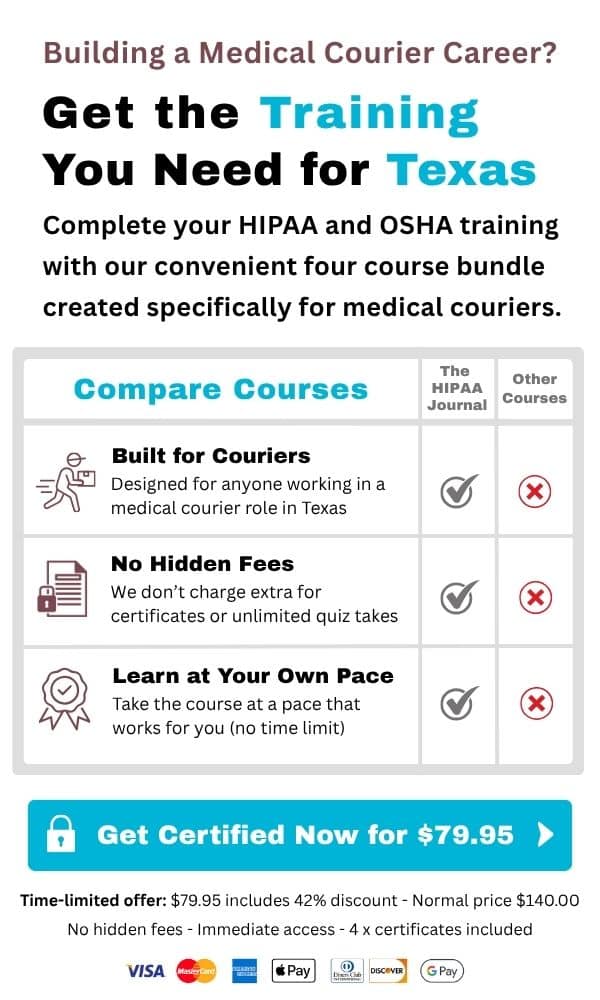
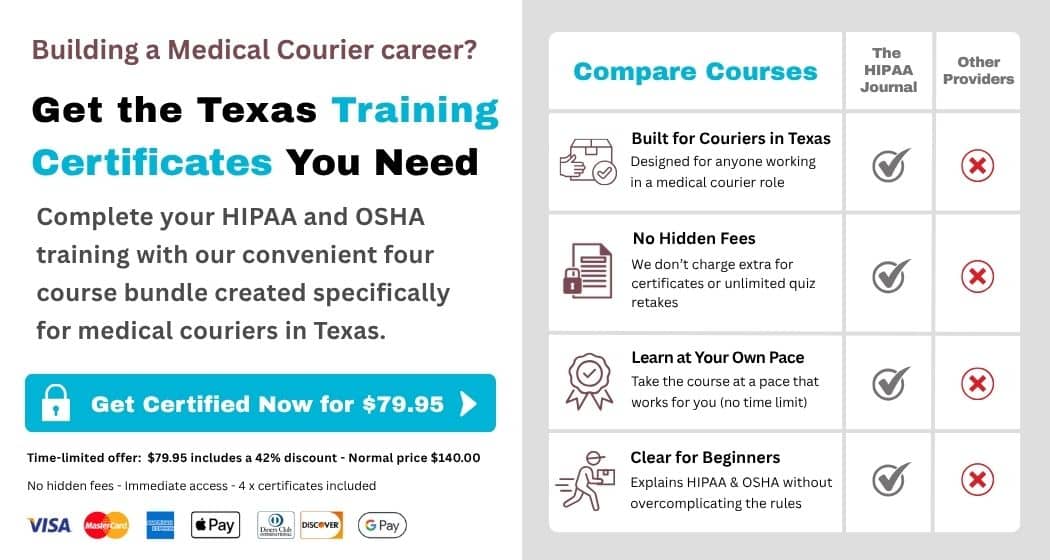
The HIPAA Journal’s Medical Courier Certification in Texas is a four-course training bundle built for the medical courier requirements in Texas. The bundle includes HIPAA training covering the HIPAA Privacy Rule, HIPAA Security Rule, and HIPAA Breach Notification Rule as they apply to medical courier work, a dedicated Texas State Medical Privacy and Security Regulations module addressing HB 300 and related state laws, and three OSHA modules: Bloodborne Pathogens, Hazard Communication, and Personal Protective Equipment. These are the courses that clients will require medical couriers in Texas to be certified on.
Certification Benefits for Texas Medical Couriers
For an individual medical courier working in Texas, Medical Courier Certification in Texas covering federal HIPAA requirements, HB 300, and OSHA standards provides proof of the training required by clients. That documentation can be shared with healthcare clients or an employer.
Medical courier companies that maintain current, documented training across their Texas staff are able to demonstrate compliance with both federal and state requirements when a client requests evidence of training.
 PJ Murray is the founder and publisher of The HIPAA Journal. He has more than 10 years of experience writing about HIPAA, healthcare compliance, patient privacy, and the protection of medical records. Through The HIPAA Journal, PJ helps healthcare organizations, business associates, and their employees better understand HIPAA regulations, reduce compliance risks, and strengthen the safeguards used to protect patient information.